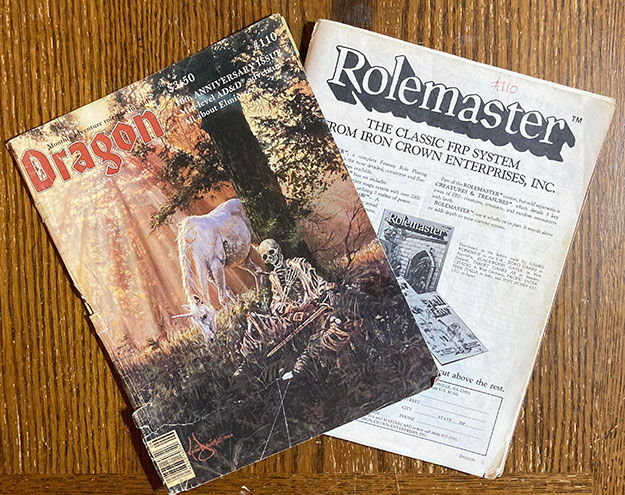
I love the cover to Dragon Magazine #110 (June 1986), which happens to be the 10th anniversary issue. The image—the skeletal remains of an adventurer at the base of a tree, still clutching at the arrow that killed them, of no interest to the nearby unicorn quietly grazing as golden light streams through the tops of the trees in this apparently isolated forest—does not appear to have anything to do with the celebratory occasion of the magazine’s anniversary, but nevertheless there is something about it that excites my imagination regarding a vision of a D&D world, which as we’ve seen, was influenced by Dragon in no small part. The cover suggests a deeper world where events and stories await discovery to incite adventure. It invites exploration and implies a secret or forgotten history. “The Vanquished Cavalier,” as it is called, may be Kevin Davies’s first cover for Dragon Magazine, and it may not be quite as perfectly rendered as some others, but it does the trick for me. It is both the end of an adventure and a new adventure’s hook.

Oh, and in case you are keeping track, my copy of #110 also has its cover detached, just like seven of the previous issues I’ve covered for Dragon Mag Monday. Eventually we will get to issues in better shape…eventually.
Kim Mohan’s editorial discusses new directions for the magazine, including introducing “The Role of Computers,” a monthly feature focusing on fantasy and sci-fi themed computer games and RPG aids. He mentions how he had received nine letters asking about “The Electric Eye,” which was the previous foray into this “new” area for RPGs. Mohan also discusses his goal for the next 10 years, if he should still be around (hint: he won’t be around much longer), which is keeping people buying Dragon, while not “treading water.” In other words, to continue to push the bounds of the magazine and not just maintain a base readership by doing the same thing over and over again. I mean, that just seems like the basic job description and not really all that interesting a subject for a 10th anniversary editorial, but what do I know? I can also imagine running out of interesting things to say after 10 years.
The Forum’s three letters are hardly worth commenting on, except that the debate on the “officialness” of Greyhawk and Gygax foisting his own world on Dungeon Masters continues with similar objections to those Daniel Myers expressed in Dragon #107. In this case, R. Zane Rutledge, explains how he makes do with adapting material he finds appealing for his own homebrew and eschews the necessity to adhere to any so-called canonical version. It amazes me that this kind of discussion continues among D&Ders to this day, but nowadays—at least online—it seems flipped, with a sizable audience complaining about the affects changes to “official setting” canon has on their games. Personally, I can’t imagine caring, especially since no lore survives contact with a group of PCs. It is nice to have “official” material to steal from but to be beholden to it cedes what I think of as a necessary authority from the DM to some people in an office in Lake Geneva or Renton who are never gonna play at your table.
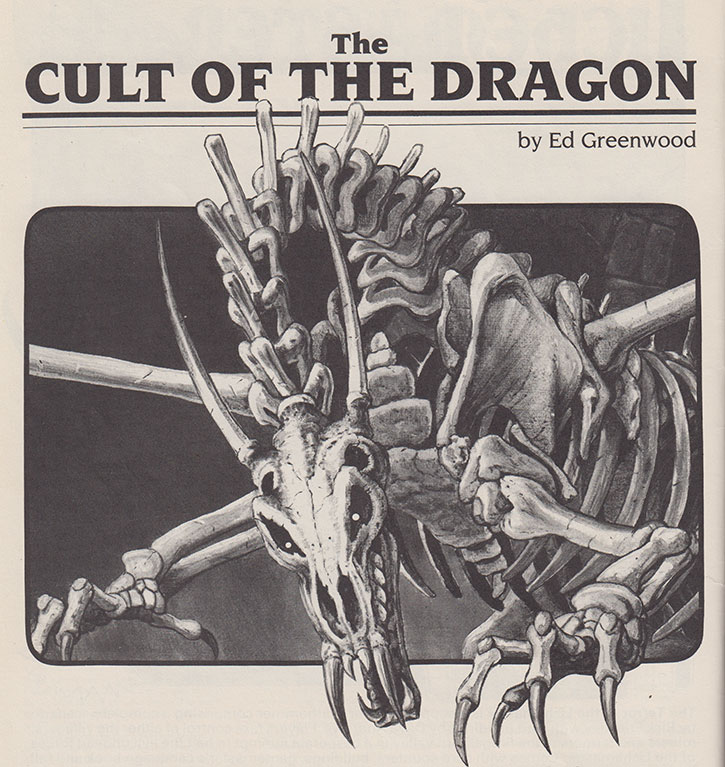
“The Cult of the Dragon” brings our Greenwood Count to 15. The article—which is the first delve into dracolich-making that I know of—starts out with discussing Dragonlance, since I guess the popularity of the setting and its novels make it a point of comparison for detailing elements of another setting involving dragons. Greenwood argues that Dragonlance material is too difficult to integrate into a non-Krynn setting because of the dominance of dragons and offers the eponymous cult as a faction that is broadly transferable from his Forgotten Realms. He writes that while “Krynn is an admirable setting” it is “too polarizing a world for casual adventuring.” This intro seems like a strange flex and could even be read as a competitive flash from jolly old Ed.
I love the “HOW I RUN IT” vibe from this article. Greenwood explains that he has been running adventures that feature the cult for five years for a group of “quite energetic players,” evoking the sense that this is well-tested and table-developed lore he is sharing with us. As I have mentioned before, these Realms articles and Greenwood’s approach in general were a huge influence on me. I am always going to prefer the bits and pieces of the Realms we got and could reimagine or simply recontextualize into our own settings to the multitude of boxed sets, modules, tie-ins, and meta-plot stuff that would soon inundate game stores and the minds of Realms enthusiasts. It would be easy to chalk that up to nostalgia, except it is not so much the details of the lore and other content I gleaned from these articles, but how it shaped my own approach. I don’t have a particular fondness for the Cult of the Dragon or the Harpers or whatever, but I do like seeing the sources for my own versions of those kinds of factions (among other facets) that Dragon Magazine inspired.
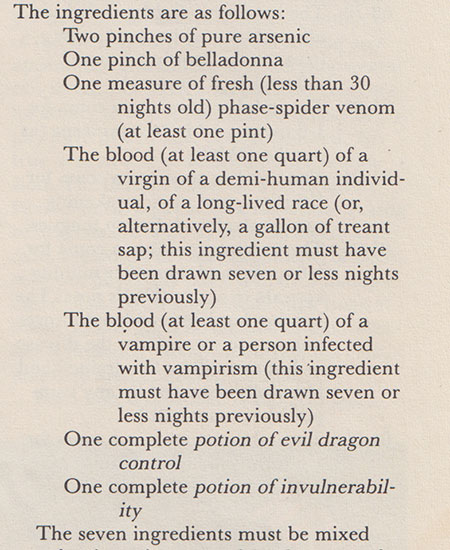
The article is incredibly detailed (I might even say, overly so) and explicates the processes for dragons to achieve lichdom and how the cult goes about recruiting dragons towards this end. This is how detailed it is: the process for creating the potion that the dragon must imbibe as part of the transformation ritual requires the concoction be stirred with a +2 longsword of dragon-slaying by the light of a full moon. Upon revisiting the article, I have come to think that the very details that once lit my imagination are absurdly baroque and an example of lore that in some ways is transforming the work of Dungeon Master prep into a solo mini-game. Which DMs are really adding up all the various modifiers and making the rolls to see if some cult cell has succeeded in transforming some dragon into a lich? Which games include players whose characters might actually try to make a dracolich? And if the chances are not upfront and center in the playing of the game, why not just handwave it all and provide an evocative and flavorful description of the ritual in its place? But I guess AD&D just wasn’t AD&D without convoluted tables of percentage modified esoterica.
Included in all of this, of course, is a stat block for the generic dracolich, a monster that would not make it into a 1E monster book or module but would re-appear in second edition. Essentially the stat block is what would be called a “template” in 3E. It provides the guidelines for modifying different dragon types who go through the change.
Not included (surprisingly, to me) is any reference to Dragotha, the undead dragon mentioned in White Plume Mountain. I have to assume that eventually she was retconned in game material to be a dracolich, too.
Ultimately, “the Cult of the Dragon” provides a great potential set of nemeses for an adventuring party, as they frequently find themselves competing in seeking out old treasures and magic items the former hope to use to fund and fuel their obsession with remaking dragons into undead form. Why do they do it? True to his detailed form, Greenwood explains that a potential mistranslation of an oracle’s prophecy led the founders of the cult to believe that one day “dead dragons” would rule the world, and thus want to be on the winning side. Typical fantastical villainy. Ya gotta love it.
“For Better or For Norse” is two articles (by Joel McGraw and Carl Sargent) presented as two parts of a longer one. It seems that there is something in the air when it comes to some D&D ideas and people end up independently sending in related work to Dragon Magazine around the same time. The editors then combine them. Both parts expand on the Norse pantheon, part one by exploring the oft-overlooked Vanir, who are overshadowed in the recently renamed Deities & Demigods (now the presumably less offensive Legends & Lore to appease Satanic Panickers) in favor of the Aesir and part two, redefining the better-known gods like Freya and Loki by digging into stories about them. For example, Loki is not so much evil as he is the type of guy who’d fuck a horse if it meant pulling off a clever trick.
And now with, “All About Elminster,” our Greenwood Count jumps to 16. This article does not tell you much about Elminster’s past but does provide a stat block for the 26th-level magic-user and a few of the spells and defenses he has at his disposal. Greenwood includes Inscribe, a 6th level arcane spell that is overly long and overly complicated, and that, as far as I can tell, only accomplishes the task of being able to copy a spell a wizard does not yet know. Remember, back in the day, it was not enough to simply go up a level, or even find a spell book to copy, wizards had to roll to see if they were even capable of learning a spell. I miss those days, to be honest. There is also a custom version of Contingency, called Elminster’s Evasion and Worldwalk allows the caster to travel directly to alternate prime material planes (thus explaining how Elminster travels to Earth to for his pow-wows with Ed Greenwood as the fiction’s conceit would have us believe).
“The Role of Computers” spends a lot of time introducing the new feature and clearing its throat about types of computer games before diving into the Macintosh version of Wizardry, which the co-authors—Hartley and Pattie Lesser—rave about. Ultimately, however, I don’t know enough about Wizardry or care enough about this outdated genre of video game to have read the article very closely. Even back in the day, I would not have read it since I did not have access to a Mac.
“Dragon Damage Revisited” amends “Dragon Damage Revised”—which appeared a year earlier in Dragon #98 and provided new rules for dragon attacks—by revising the damage for attacks by dragons that appeared in later monster books, such as the Fiend Folio and Monster Manual II, along with the neutral dragons that appeared way back in Dragon Magazine #37 (and reprinted in Best of Dragon vol. III). The argument in the earlier article, and thus in this one as well, is that base dragon damage for its claws and bite should increase as the dragon’s age and thus power increases. Makes sense to me.
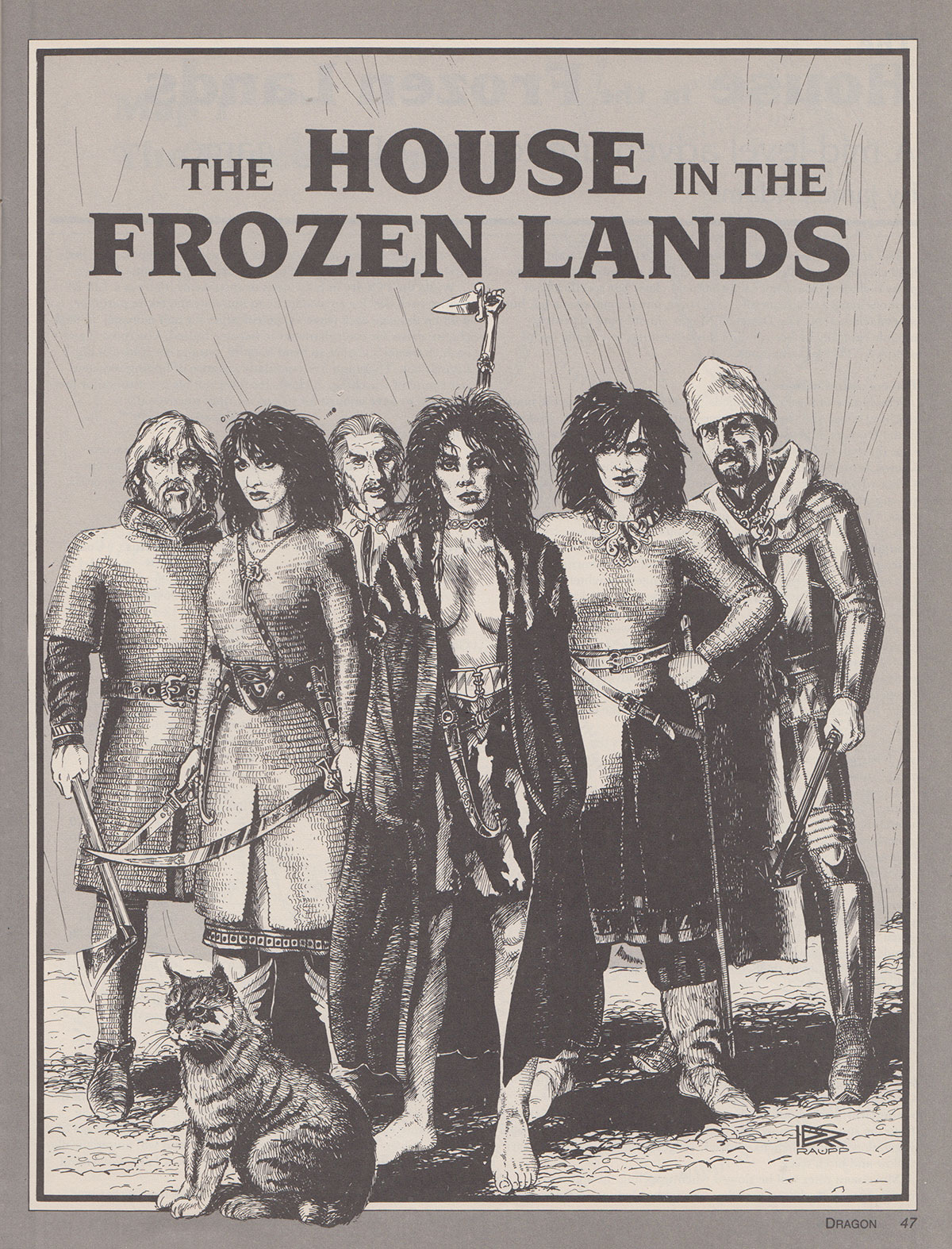
“House in the Frozen Lands” (by James Adams) was a pleasure to revisit and is the standout feature of this issue. Sure, the Cult of the Dragon and stats for Elminster may have been sexy, but this rather straightforward adventure resonates with my own more “down-to-earth” and gritty approach to D&D. Practically speaking, it is not only more useful than a lot of info in this issue’s articles, but personally I adopted the background and cultural info regarding the factions involved directly into an equivalent area of my old homebrew, Aquerra. I only ever ran the adventure once—for my high school group and before Aquerra existed—but I liked it enough to make sure I not only had a place for it when that setting was new, but I used it as a basis for the barbarian tribes of the Northern Reaches (a rather generic name I actually stole from BECMI’s Known World setting).
“House in the Frozen Lands” is listed as being for 4th to 8th level characters, which is a huge range and from re-reading it now and running it once, characters at the lower end would have a serious problem completing it. That said, a full party of 8th level characters might find it too easy. Such gaps and variation in PC level were more common back in the day, but while even my 5E games might have a discrepancy between PCs of a level, it’d very rarely be as much as two levels and never more.
The adventure’s set up is a little too simple—though simple is not a bad thing in and of itself—and I think in order to be incorporated into an ongoing game better, the DM would need to do some work to set-up the hook and create some more bonds for the PCs involved and thus increase the stakes for completing the adventure. As written, the PCs simply need to retrieve a schoolmaster from an isolated arctic school where the children of nobles and other rich folk are taught, far from the influences and dangers of court. The noble father of one of these students wants to appoint the schoolmaster as an advisor. The PCs are meant to deliver the message and bring him back if he accepts. Of course, a barbarian cult—known as “the Sept of Infamy”—who wants to use the caverns beneath the school for their own nefarious purposes complicates this simple goal.
It was running this in high school that increased my interest in using the Ancient Egyptian pantheon in my D&D games. While the adventure is set in an arctic region, the schoolmaster and the school staff are adherents of Ptah. As a result of this, this pantheon became the central one for my homebrew, despite a similar—if distinct—climatic gap between my setting and ancient Egypt. As I mentioned above, this was not the only influence on my then forthcoming homebrew setting, as the naming conventions and familial hierarchies became vital to making the barbarians of Aquerra’s northern lands distinct from all others (save perhaps the adventure author’s own home setting, which is where I imagine he first came up with this stuff). Furthermore, the barbarian cultists are adherents to the twisted faith of Loviatar, the Maiden of Pain, a goddess from the Finnish Mythos. Guess which mythos I chose as the basis for the gods of the Northern Reaches in my homebrew?
A few more things about “House in the Frozen Lands”—I know I have taken up a lot of space on it, but let me reiterate, it is the most useful and interesting thing in this whole issue—as with many early adventures, the first part of it involves a dangerous journey through (in this case, arctic) wilderness. The author includes more info than you’d think is necessary about the ecology of caribou, which the PCs might run into. Furthermore, there is not only a chance for an avalanche that could kill the whole party before they even get to the school, but the random encounter table makes it just as likely that the PCs could encounter a sable or mink as it is to run into a white dragon or remorhaz. I do love the possibilities of random encounters, but sometimes I think they’d be better as a list of potential encounters for a DM to choose from rather than risk the whole game falling victim to the tyranny of dice. And I say that as someone who generally rolls in the open and doesn’t fudge. It is just that not everything needs to be rolled for.
I love the accompanying art by Roger Raupp. The cover art of the cultist band is fantastic. They look badass, desperate, and dirty.
As I alluded to above, Adams clearly included a lot of material from his own campaign world and the references to hooks a DM might further develop—like the Crystal Caverns—not only delighted me then but delight me now. I like my adventures capacious, and this one is exactly that.
The adventure scenario was also a big influence on me, as it is not so much a dungeon crawl as dropping the PCs into a violent political situation they may not be aware of upon arrival and based around the actions of a few powerful and colorful NPCs and their minions.
Lastly, in addition to several typographical mistakes in “House in the Frozen Lands” I noted, the maps are missing room labels in some places, or the text makes references to stuff not clearly on the map. My 35-year-old copy has notes in my 15-year-old’s scrawl denoting the angle and slope of tunnels in hopes of describing it more readily when PCs are navigating it because on its face it can be confusing. My guess is that these errors are artifacts of the adventure being cut down for space and the punishing deadlines of a monthly periodical.
I am going to be looking for a way to adapt and run this adventure again soon.
Dragon #110’s fiction is a long short story entitled “The Wizard’s Boy,” which I remember reading more than once back in the day, but as most of the short fiction I have encountered in perusing these old Dragons, I did not reread it (but if I were going to choose one to reread, I’d probably start with this one).
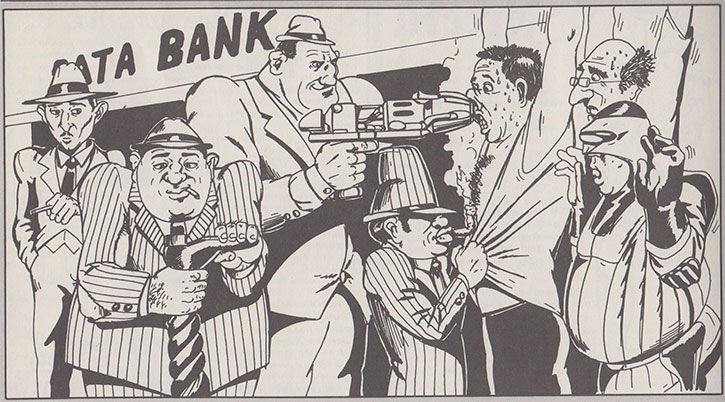
The ARĒS section of the issue has articles regarding the usual suspects in the sci-fi gaming world (and adjacent genres). “Knowledge is Power” presents a skill system for Gamma World (not sure which edition, since a third edition came out this same year), “the Marvel-Phile” presents a few different versions of everyone’s favorite flame-skull, Ghost Rider, the unimaginatively titled “Going for a Swim?” presents rules for underwater environments and equipment for Star Frontiers, and—my fave—“Piece of the Action,” provides detail for a mafia-obsessed secret society for Paranoia. I love that game. That last article includes some of Jim Holloway’s typical cartoon style art, giving us ethnic caricature Italians intimidating some Alpha Complex Troubleshooters. It may not be as disquieting as Holloway’s art for the infamously racist imagery of GAZ10 – Orcs of Thar (which would come out in two years) but it nevertheless looks like art I doubt would make the cut in our ostensibly more sensitive times.
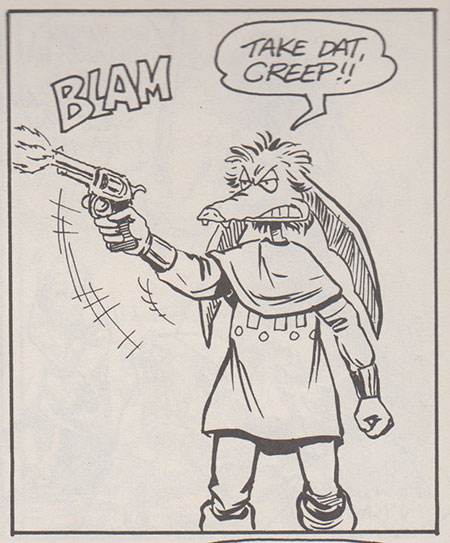
This issue’s SnarfQuest concludes the battle against Gathgar. Snarf gets the credit for defeating the evil wizard (he tries to shoot him with a gun, which he sees as a magical item) but the death leech is really responsible for saving them and winning the day. Gosh, I love that death leech!
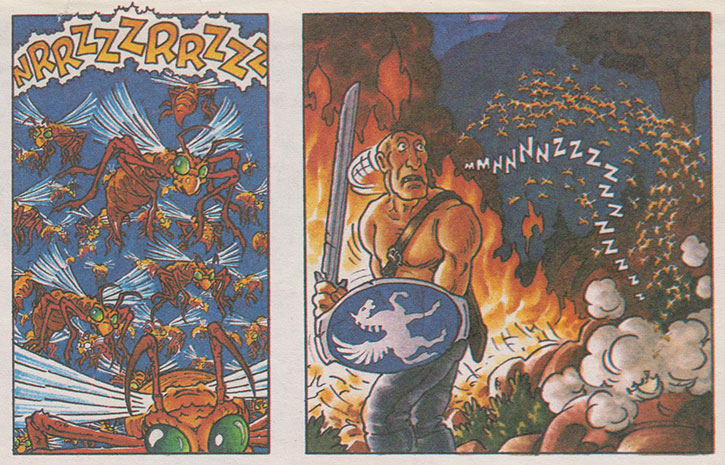
Rereading Dave Trampier’s Wormy in this issue, I am reminded of how sad I am that there has never been—and probably will never be—a collected Wormy book. There is such an amazing splash page reveal that ends the comic installment and issue but never having had Dragon #111, I am not sure how it was resolved. While I don’t have much desire to complete my collection of Dragon Magazines the way I still am trying to fill gaps in my collection of Dungeon, I sometimes do consider if it might be worth it to try to get the full—if ultimately incomplete—Wormy run. Despite the lack of closure, the installment it still fun, as the titular dragon’s cycloptic best-bud fends off a couple of bounty hunter giants who turn out to be smarter and scarier than he thought.
In the end, this is a memorable issue because of Ed Greenwood’s contribution of two articles that seem foundational to D&D lore, even if on the surface it seems like primarily Realms-related, since both Elminster and the Cult of the Dragon are elements that have their iterations in many, if not most, D&D settings. However, it is the inclusion of the module, “House in the Frozen Lands” that had the most influence on me, and I am glad that I reread it. I plan to scan its pages into a PDF and print it out so I can keep it on my mind when looking for possibilities of adventures to adapt for my current 5E games.
Next time Dragon Mag Monday rolls around, we’ll be skipping Dragon Magazine #111 (which as I said I never owned) and jumping to #112 and August 1986!
 HOW I RUN IT.