n.b. Welcome to Troglodyte Tuesday! A feature in which I present (or re-present) monsters I have created or adapted for use in my own 5E D&D campaigns, including lore, tips for running them and a stat block.
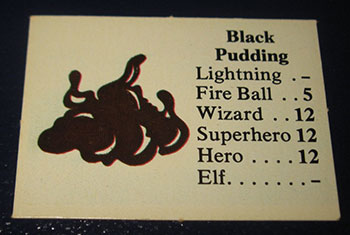
The first time I saw a Black Pudding it was being referenced on a monster card from the DUNGEON! board game, which I got for Christmas from my uncle in 1982. Later, I’d spot it in the AD&D 1E Monster Manual but never really considered using it or came across it in a module. I really didn’t use oozes and slimes at all. Sure, player characters would occasionally run into a green slime hazard and a couple of times I used grey oozes because their psionic powers interested me, but in general? Oozes seemed too weird and potentially difficult to adjudicate.
I am not sure what changed for me. Perhaps it was the Yellow Mold found in a room in U1 – The Sinister Secret of Saltmarsh, but after I ran a sidetrek adventure from Dungeon Magazine #29 (May/June 1991) entitled “Through the Night,” which features a Slithering Tracker in my Revenants of Saltmarsh campaign, I decided I wanted to try to use as many oozes as I could get away with. And while I found the 5E stats for them in Volo’s Guide to Monsters, true to my approach to D&D, I tweaked the monster for my own needs and to better emulate both the versions from previous editions and to codify some of the suggested abilities from those older descriptions.
As so, the next opportunity to include an ooze arrived, I went for what I consider the classic Black Pudding. Or, as a friend likes to call it “The food that wants to eat you.” This post is the result of that choice.
Oh, and I guess if you play in my D&D games, be ready for more oozes!
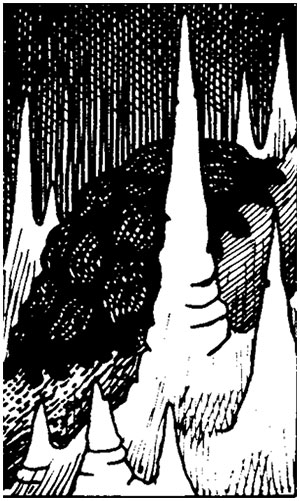
The description of the Black Pudding in the AD&D 1E Monster Manual starts off with a interesting description of its composition (in the mix of medieval bestiary and anachronistic pseudo-science common to Gygaxian writing), calling it “a monster composed of groups of single cells.” This sentence alone led me to the “Deathless” ability I gave the pudding. In other words, unless killed in a specific way (fire or radiant damage), the Black Pudding will eventually grow back to full size. Now, this won’t matter in the vast majority of cases, since it takes 1d4 years to regrow, but in terms of the world-building aspect of monster creation, it is the kind of thing that might explain (for example) why there is still a black pudding in some dungeon cleared out previously by adventurers some years ago. Or it might inspire a DM to create a stat block for a Tiny or Small sized Black Pudding (something the AD&D version includes in its descriptive text). Or be a required component of some spell or in some magical item creation that grants regeneration or longevity.
The corrosive ability of the Black Pudding is not as standardized or play-friendly in 1E as it is in later editions. The entry does include rules for dissolving mundane items, but also magical armor, with each “plus” making it take one round longer to be completely eaten away. This is something I considered including for my version, but since 5E does not include item saving throws, I found it too punitive to adapt. There is a part of me, however, that is considering putting it back in for my games – but that is the kind of DM I am. Similarly, the Split ability is not very well detailed, simply reading that if it is “chopped or struck the monster is broken into two or more parts.” I guess that kind of ambiguity gives the DM a lot of leeway to do it as they want, but the DM has that leeway even when it is detailed, and a more rigorous guideline or rule is very useful not only for new DMs but just to remove the necessary cognitive load on a DM of any level of experience.
Oh, and the entry describes Black Puddings as having lots of little mouths, which 2E keeps but. .. I have never pictured them that way and just think of them as exuding their digestive juices through microscopic pores.
In 2E AD&D, the Black Pudding is a subspecies of the Deadly Pudding, which also includes white, dun, and brown puddings. Why this variety? It is not clear. White Puddings look like snow or ice, always surprise, and are extra corrosive. Dun Puddings are found in deserts and are less corrosive, but do dissolve any leather (even magical) in one round. There is nothing special about the Brown Pudding, except it lives in marshes and does very slightly less damage with its attack. The text does, however, generously remind us that “Other pudding types are possible, at the DM’s option.” Gee, thanks.

The 2E Monstrous Compendium provides detailed rules for using the number of hit points rolled for the monster to determine its actual size. Yes, my children, back in the day it was assumed the DM rolled the hit dice for a monster to determine its hit points, not just take the average. I sometimes still do this, but since 3E days I mostly just choose a number in the range I think is appropriate. In fact, I usually use the average as the hit point floor, and I tend to choose a total between it and max, unless I am specifically choosing to have a weaker or injured version of the monster (which I also sometimes do).
I’ve never owned the 3.5E Monster Manual, but the Black Pudding in the 3.0E one is definitely the most powerful. I think my vision of the monster’s abilities are the most influenced by this version despite never having used it. These Black Puddings are Huge sized, have the Improved Grab feat, and the arms and armors of those who fight them dissolve immediately unless they make a DC 19 Reflex save every time! And if you are constricted by it, that save is made at -4! Not only do all weapon attacks split it, but they deal no damage, and the puddings can split as long as they have 2 hit points or more. Wild. This increased corrosiveness survives in my version in terms of damage to gear when a creature is enveloped.
For my version of the Black Pudding, I kept in the forefront of my mind the image of this multicell pudding creature that has no organs, or brain, or blood, but is capable of continuing to live even if split apart. Thus, while I kept 5E’s change to the Split ability to be a result of blows from slashing weapons, I made them immune to slashing damage and gave them resistance to damage from bludgeoning or piercing weapons. I just can’t see how such weapons can do much but maybe whittle away at their consistency some, and while some of the pudding’s essence might splash away, some must be reabsorbed. And with their fragmented cell colony minds, I also made them immune to psychic damage.
I made them more dexterous, but still getting a penalty because I see them as lumbering. I just think their amorphous stretching and contracting body should offer some degree of agility. Ultimately, this is a cosmetic change as it is not that much harder to hit AC 9 as it is to hit AC 7.
I made them more intelligent. I wanted them to be scary in their hunting instinct, being able to demonstrate some forethought and strategy. So, I gave them the equivalent intelligence of a baboon, according to D&D.
Smart and silent makes them scary.
To add to the silent part, I made Black Puddings actually be good at stealth and to be difficult to spot even when in the open, if they lay themselves flat to look like a puddle.
I increased how much bludgeoning damage their pseudopod does, and I added an Enveloping ability. This is based on language in the very description of the monster in the 5E Monster Manual, comparing a Black Pudding to a Gelatinous Cube’s method of attack and using the word “engulf” for both of them. But while I see the Gelatinous Cube as an irresistible hazard moving ever forward, I think of the Black Pudding as cunning. Once it strikes, however, I wanted it to be relentless, not only as a way to amplify how scary it is, but also a form of weakness. Once it sets its sights on some food, it cares about little else until it has engulfed it and has begun to digest. These puddings are strong and are actively working to keep their prey inside their bodies (thus their advantage to grapple).
I played around with the idea that Black Puddings can engulf more than one creature depending on their size, but ultimately, it felt like a needless complication that was stepping on the toes of the aforementioned Gelatinous Cube.
Lastly, I gave Black Puddings tremorsense, asserting that they “see” and “hear” based on vibrations along the ground and to some degree in the air (though flying creatures are effectively invisible to them).
Below you will find descriptions of the creature, a full stat block, and a link to the PDF version of the full description and 5E stat block. (For more info on the changes to stat blocks on HOW I RUN IT see the About STAT BLOCKS page.)
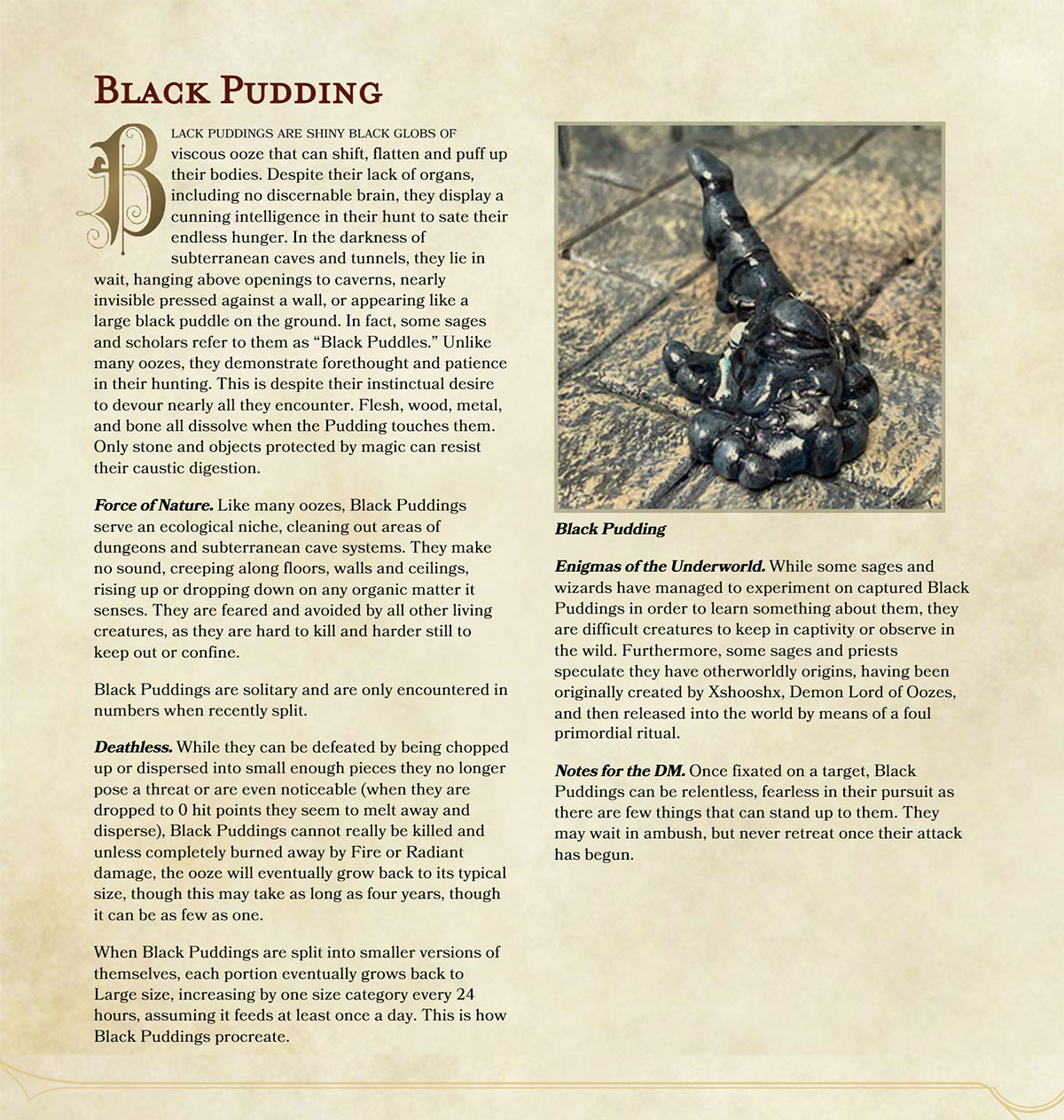
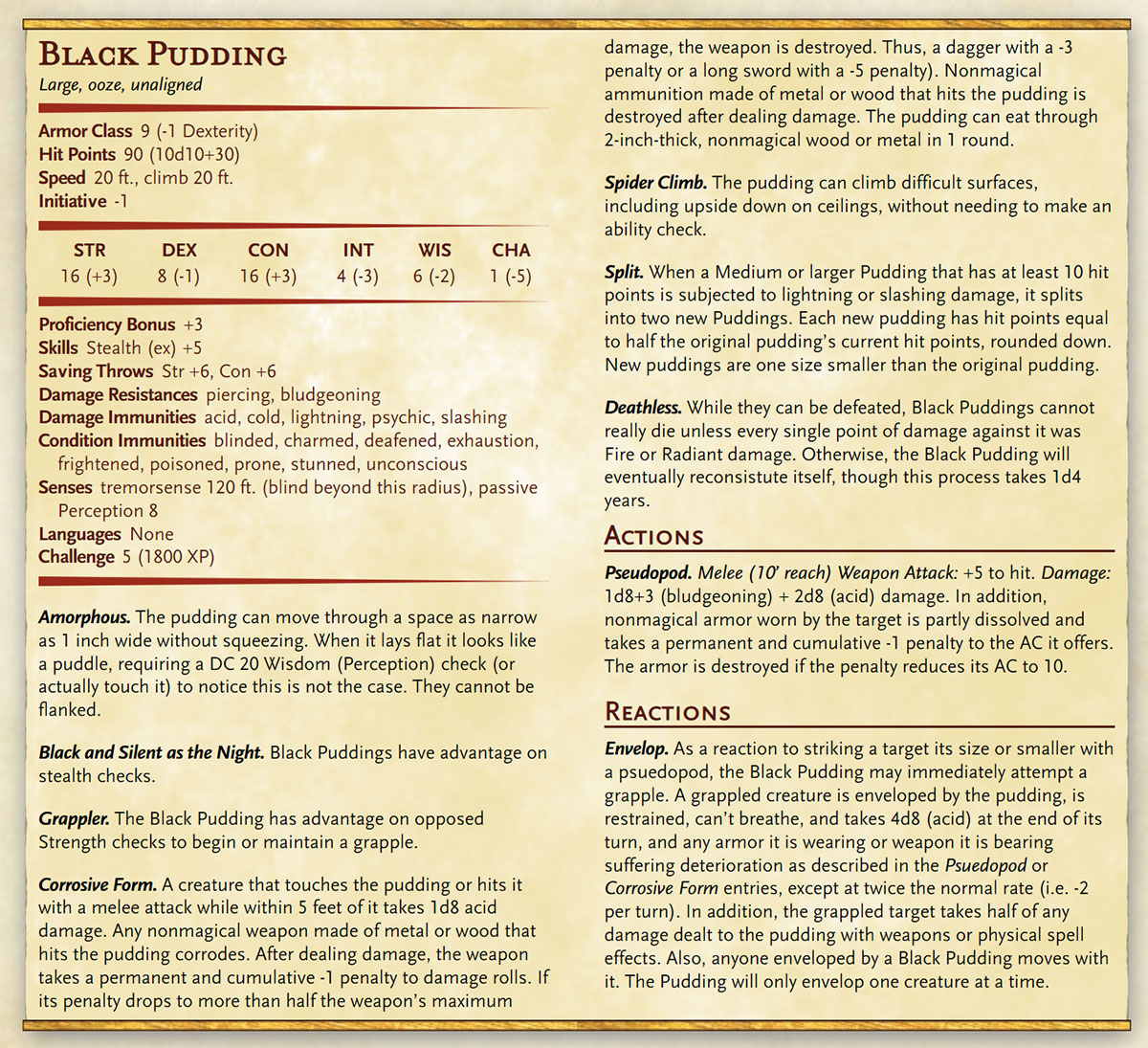
Click here for a PDF version of full description and stat block.
 HOW I RUN IT.
Leave a comment