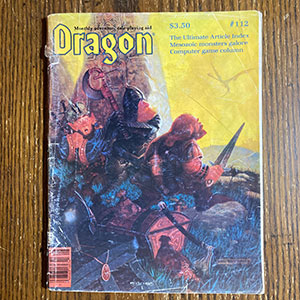
The cover to Dragon Magazine #112 (August 1986) was not one I would have necessarily recalled without the refresher of pulling the issue out of the box to review it. However, once I saw it, I of course remembered it and the story artist Daniel Horne relays (via editor Kim Mohan) about its inspiration—a dragon-shaped cloud he and his buddies spotted when out hiking while doing fantasy cosplay (though no one would have called it “cosplay” back then). The painting is untitled, but Mohan calls it “Easy Pickings,” thinking it fitting no matter if you consider it from the dwarves’ or dragon’s point of view. While I like the theme—who doesn’t like dwarven adventurers? I’ll take a dwarf over any of the countless species introduced as player character choices since the 80s—I think the foreground of the image, the treasure is, is both too muddy and takes up too much of the space, leaving the actual subjects (the dwarves and the dragon) mostly filling the top right third. In my memory, the editorial note on the cover art also included a photo of the artist and his friends in costume, but that is not actually the case, demonstrating how much our minds confabulate what we call memory.
At least the cover is still attached, if only barely, unlike most of the issues in my collection I have covered so far.
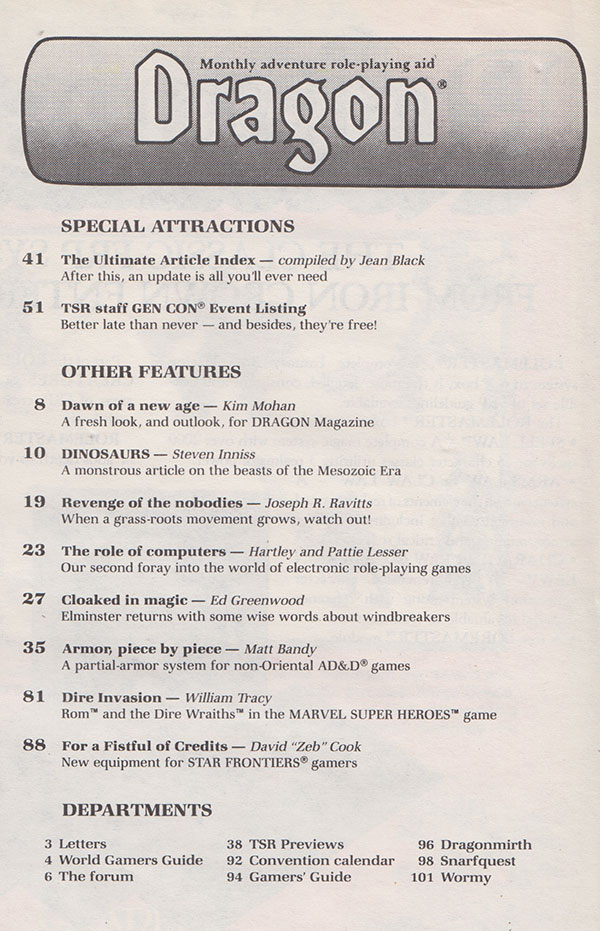
Another reason why the issue is kind of unmemorable is that there is not much in there worth remembering. Most of the issue is taken up by an unreasonably long (you might say “padded”) article re-doing dinosaurs for AD&D and giving some suggestions on building encounters with them and introducing them to your setting, and by “The Ultimate Article Index,” going back as far as Dragon #1, but not including issues of its predecessor, The Strategic Review. The dinosaur article takes up 18 pages. The index is spread across 19 pages. That is 37 pages of a 104-page magazine. In other words, too much.
At the time, I remember finding the index very helpful, despite only owning about 10 of the 112 issues that had come out so far (plus two of the Best of…volumes) and, it was the kind of thing I wanted them to revisit and expand later on when I had closer to 50 issues and later still 100 issues, but looking back from the current moment it feels like a waste of space and effort. First of all, as Mohan explains, many of the issues referenced were out of print even back then and getting them as back issues was not easy. Secondly, if it took 19 pages to include a index of 112 issues, if they did continue to update it every 50 issues or so (the previous update before this one was in issue #76, which only went through Dragon Magazine #74), imagine how many pages it would take to index 200 issues or more! Thirdly—and they had no way of knowing this at the time—printed indexes for a periodical would eventually be obsolete. These days an online index is a lot more useful. There is one called “The DragonDex” maintained by fans that I use often.
While the index does not break down the articles by author, it did allow me to check and see that of the 28 “Ecology of…” articles printed at this point, 16 of them were written (or co-written) by Ed Greenwood!
This would end up being the last index printed in Dragon. If I remember correctly, the question of when it will be updated (as promised in this issue) will come up a few times in letters to the editor, but eventually the answer given back would be, “Never gonna happen.” The closest thing to it would be a “Top 10 Issues of Dragon” article printed in issue #359 (September 2007)—the final print issue of Dragon.
The relative enormity of the “Ultimate Article Index” seems to also cause some layout issues. The aforementioned dinosaur article, (unimaginatively entitled, “Dinosaurs”) appears to end on page 16. However, after four more articles, the index, and the “GEN CON 19 TSR-sponsored Event Listing” (which is crammed into the middle of the index), “Dinosaurs” continues on for another 12 pages!
Speaking of the GEN CON 19 Event Listing, a note at the beginning of it gives us a sense of how the wheels were coming off the bus at TSR in the mid-80s. Essentially, the people coming up with the TSR-sponsored events missed the deadline for the Pre-Registration Brochure, so printing them in the pages of Dragon was the next best solution. It also meant that no one could actually pre-register for these events but would have to read about them here and then register at the con itself. Sounds like a mess.
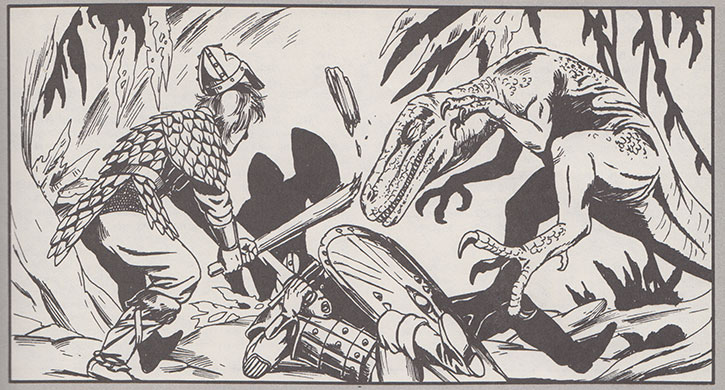
Since I already mentioned “Dinosaurs,” rather than jump back to the beginning of the issue, I’ll briefly discuss something aside from the onerous length of Stephen Innis’s article on the Mesozoic animals. The article reconsiders and reorganizes dinosaurs and related creatures, looking closely at the hodge-podge of dino stat blocks in the Monster Manual and other AD&D books. It provides new stat blocks, breaking them down into five simple categories…but wait, not really! Remember how I said that the article is weirdly broken up? Well, even the usual “continued on page X” or “continued from page Y” note is absent. If i had been paying closer attention, I might have noticed it ended mid-sentence, but that’d be no less confusion with no sign that it continues eventually. Anyway, so, when I stumbled upon the rest of the article, my extreme satisfaction with what I assumed was trying to pare down and simplify all the kinds of dinos, was burst by the realization that there were instead TWENTY-SEVEN categories. Each one having a stat block that offers a range of possibilities for the type it describes based on size and other qualities. It simplifies nothing. Instead, it is yet another example of 1E AD&D’s penchant towards over-complication in pursuit of unnecessary simulationism that actually bogs down any feel of reality with overwhelming detail. This is just the dinosaur version of the ponderous “Collection of Canines” article from Dragon #102. And guess what? Stephen Innis (misspelled “Steven” in the table of contents) wrote that one too.
Anyway, let’s jump back to the beginning of the issue.
The other thing that makes this issue notable is that it is the first one to feature changes made to the periodical based on a survey the magazine had included in Dragon Magazine #107. While I covered that issue in a previous Dragon Mag Monday, I must have filled out the survey, torn it out, and sent it off, since it is no longer in there, and I remember filling out various Dragon surveys over the years. This must have been the first one. In his monthly editorial note, Kim Mohan bemoans how no matter what changes they make (or don’t make) there is going to be a percentage of readers who are unhappy. He explains that very few questions had even an 80/20 split in responses, many more had a 70/30 split or a 60/40 split or even close to 50/50. This means that even if a change is preferred by the majority, more than 40% of readers might still be seriously unhappy with it. Sounds like politics!
In “Dawn of a New Age,” Mohan explains the specifics of the changes, and I have to say, while some of the changes are notable—no more ARĒS section, for example—none of them seem big enough to earn the “new age” moniker the editor-in-chief is using. So yeah, no ARĒS section (though the typeface and background color they used for that section is now used throughout the mag), which means fewer sci-fi and superhero articles (though not none) because people didn’t like them, and fewer articles that are on “realism,” theoretical ideas, or built around multiple statistical tables. Well, thank Jove for those last three! There is a tendency in online spaces to assume, based on what D&D looked like back then, that detailed simulation is what players wanted, but there have always been a vocal element who found the granularity of AD&D to be boring, dry, and needlessly complicated.
The letters column includes a letter from the author of “Death of an Archmage” (an adventure that appeared in Dragon #111 that I always wanted but have never had) providing errata and corrections for it, and another from a reader (Mike Sostre of Brooklyn!) pointing out errors in “House in the Frozen Lands,” none of which are errors that I pointed out when I wrote about issue #110. So yeah, we are in Unearthed Arcana territory in terms of poor copyediting.
“The Forum” is finally getting good!
Margaret M. Foy (who would go on to pen one of my all-time favorite Dragon articles just a few issues from now) writes in to argue that using real world pantheons of gods for D&D is disrespectful, especially for so-called “pagan” religions. She specifically points out examples included in Deities & Demigods (retitled Legends & Lore) like the inclusion of Hindu and Native American gods, but does not limit it to these, saying that there are still adherents to Celtic, Nordic, and African gods and religious customs which have found their way into the game. She goes on to say that “[s]ince TSR’s products are so popular among children and young people…it is especially important that these products not endorse or tolerate religious intolerance.” She ends her letter by writing, “The only sure way to avoid insulting…anyone’s religious sensibilities is to use no one’s religion and use only fictional [divine] figures generated especially for the game.”
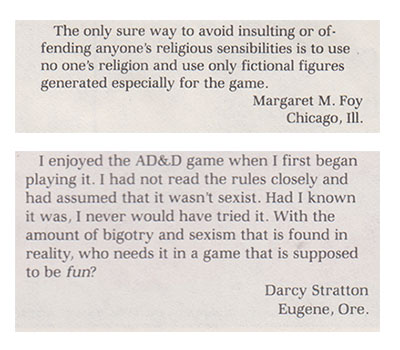
This letter is interesting to me in two ways. The first being that while a certain online and retrograde segment of gamers like to claim that cultural sensitivity and so-called “wokeness” is a new movement ruining gaming, these concerns and arguments have existed for decades. I would be willing to bet that this is not the first time this subject has come up in the discussions of gamers. In fact, another letter to the Forum in this same issue (this one from Darcy Stratton of Eugene, Oregon), complains about Kim Mohan’s article from issue #107, “Room for Improvement” and its insistence that the difference in Strength between men and women is enough to account for gender-based strength score limits, while claiming that while women have on average higher constitutions than men it is not enough to make a difference in the game rules. She goes on to complain about how these ability score limits apply to non-humans as well, as if other species would have to be beholden to our cultural ideas of physical capability. Stratton also explains how these rules severely limit the options of female characters in other ways, as not being able to achieve beyond certain scores makes it impossible for them to dual-class or advance beyond certain levels in certain classes. So, it is not just about attack and damage bonuses, but about actual advancement in the game.
The second way Foy’s letter is interesting to me, is the way in which I disagree with it. While I agree that game companies should avoid representing fantasy (and let’s face it, stereotyped) versions of gods and their following that are part of living faiths, I also think that there is nothing wrong with using representations of ancient gods. No one cares if people are worshiping Zeus, Vesta, Marduk, Horus, or Odin in your D&D game. Even if some of those gods have been absorbed into modern religious practices by some folks, those views are actually concurrent or even later than their absorption into popular culture and consciousness in a way that has nothing to do with earnest religious faith. I’m not saying you should not respect the feelings of folks at the table who might take issue, but if no one at the table objects? Heck, we know for certain that TSR and WotC are never going to print representations of Yahweh or Jesus or Mohammed, but if I am at a table where everyone is okay with including elements of so-called Judeo-Christian religious figures and elements, I am down to play. There have definitely been RPGs set in “Biblical times.”
Essentially, have good faith discussions with the folks you game with about what is appropriate for your table and work it out from there.
Moving on—but still having to deal with what is appropriate at the gaming table—we have Joseph R. Ravitts’s “Revenge of the Nobodies.” When I saw the title of this article, I perked up, because I remembered it having an influence on my DMing style of running the world, but when I actually reread it, the suggestions fall flat. Essentially the article is addressing how the DM can deal with the fact that “many heroic fantasies display [a] disregard for the welfare of the story-world’s civilian population” by thinking through the grassroots political movements that might affect the adventuring life or draw adventurers into dealing with. At its core, this is a good idea for developing your setting and one I clearly took to heart. The included examples describe movements to try to force temple clerics to share their healing and resurrection magic more fairly, ethnic resentment tied up with labor issues using dwarves and a mine as an example (one that I actually recently used in my Revenants of Saltmarsh game, but independently of this article), a movement to keep adventurers from using speak with animals to keep the animals’ mistreatment at the hands to drovers and farmers a secret, and an effort to restrict the use of invisibility in town.
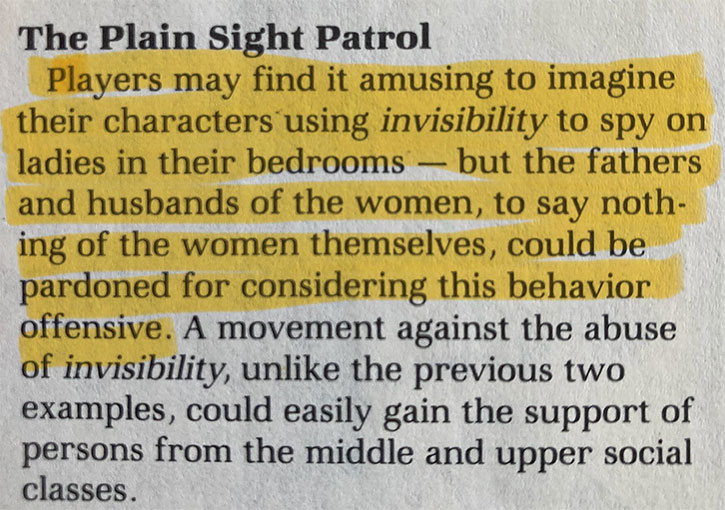
This last one really stuck out to me because of the context given for it. Ravitts writes, “Players may find it amusing to imagine their characters using invisibility to spy on ladies in their bedrooms—but the fathers and husbands, to say nothing of the women themselves, could be pardoned for considering this behavior offensive.”
WHAT?! The casual inclusion of this assumption about the common actions and playstyles of D&D games involving playing out your peeping tom fantasies at the table reveals something about the mores of the time. Yes, you can read that as an admonishment, but it is a fairly weak one, given the choice of words regarding who needs to be “pardoned.” Yes, the article goes on to give in-game consequences for this behavior, but in-game consequences for toxic male behavior leaking into the game is not the way to handle it. As I said above, there needs to be good faith discussions about what is acceptable at the table, and this is not or should not be acceptable. And yes, it is not shocking that some tween or teen boys may get up to this type of tomfoolery at the table (I was once one of those boys), but it is arresting to think that someone who is clearly not a 12-year-old boy wrote that, and the editors found it an acceptable way to broach the subject.
I’m just glad that despite whatever missteps Wizards of the Coast might make, this kind of easy acceptance of toxic behavior is not one of them.
“The Role of Computers” makes another appearance, this time exploring a game called Rogue, but more interesting to me is the article “Armor, Piece by Piece” by Matt Bandy. It presents an alternative system of piecemeal armor for AD&D based on the rules created for the ill-named AD&D Oriental Adventures book. Bandy introduces a hit location mechanic and a defensive roll to go along with it and then breaks down various types of armor and the parts of the body they protect so you can check the attack roll against the location’s AC. It goes on to explain the difference in locations that might be hit if the assailant is left or right-handed and if the defender has a shield and so on. Versions of some of this stuff is actually in the AD&D 1E Dungeon Master’s Guide, but no one I know ever used it, and at the time I read this article, I don’t think I owned the DMG yet.
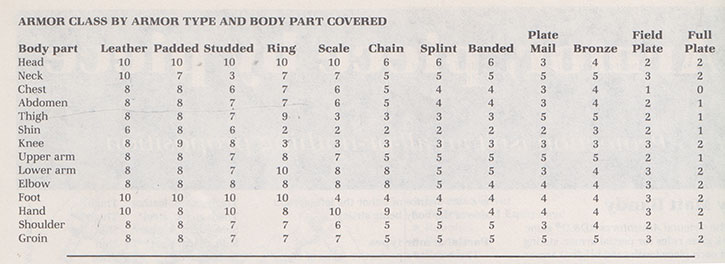
Of course, despite the slog it’d make of combat, I tried to implement this system in my games but dropped it fairly quickly. It was just too much to deal with for every potential hit. Later, in my 2E games (and ported into my 3E games), my groups did use weapon vs. armor type rules, giving each basic armor type three armor classes versus slashing, piercing, or bludgeoning weapons. We played with those rules until 2016.
Before that armor article, however, our Ed Greenwood count goes up to 17, as he presents “Cloaked in Magic,” which provides nine magical cloaks for inclusion in your D&D games. None of them stand out to me as particularly interesting on a reread, except maybe the Cloak of Fangs because its power comes along with a downside, it might deal as much damage to nearby allies as it does to enemies when it starts flinging out magical teeth in all directions!

Taking a pause from talking about articles for a moment, there are a few other items of note in this issue. There is the first ad I remember seeing for Steve Jackson Games’ GURPS (Generic Universal Role-Playing System). There is also a two-page spread advertising the DC Heroes RPG, a game I would not have tried in 1986 (being a “Make Mine Marvel/DC Sucks!” kid at the time), but that I did eventually get to try a few times about 10 years later. The TSR Previews spread includes a bit about the then forthcoming DA1 – Adventures in Blackmoor, which surprised me given that I thought by the mid-80s Dave Arneson had as little to do with TSR and D&D as possible save for his royalties and occasional visits for stockholder meetings. A little internet sleuthing, however, has brought to my attention that there was a brief time (about a year?) when Arneson—co-creator of Dungeons & Dragons—was brought back into the fold for the DA series.

The ARĒS section may be gone as of this issue, but the Marvel-Phile is still present, and if you ask me, it is the best one of all! “Dire Invasion” covers ROM: Spaceknight, the best comic series based on a discontinued toy. It includes stats for Rom (of course), both versions of Starshine, his enemies, the dire wraiths, their hellhound servants, and Hybrid, the scary half-wraith weirdo that not only required Rom to team up with the X-Men to defeat the first time but with the Brotherhood of Evil Mutants the second time (which is also the first time we see Rogue begin her turn from heel to face). Rereading this article both made me want to bust out my complete set of Rom comics (to be honest I have a nearly complete second set as well) and to play a Galador-based Marvel Superheroes game.
There is also a short Star Frontiers-based article called “For a Fistful of Credits,” detailing new gear for a game that TSR stopped supporting the previous year.

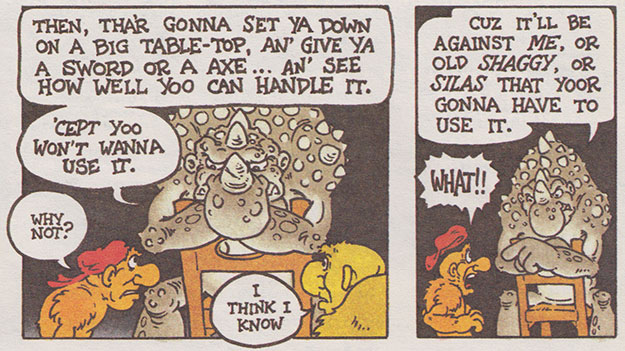
The issue finishes off with the usual comics. The one-panel DragonMirth strips are not worth mentioning, but in Larry Elmore’s SnarfQuest (strip #37), Snarf and company have a close encounter with a visitor from the same futuristic alien world as Aveeare the Robot (pronounced “A.V.R.”), who has recently arrived on a spaceship. When the visitor shuts down Aveeare for maintenance (I guess), Snarf and Telerie, who don’t know their companion is a robot—let alone what a robot even is—assume their friend has been killed! As revenge, they knock the guy out and tie him to a gagglezoomer. What is a gagglezoomer? Well, the editorial note tells you to check out SnarfQuest #17 for details. But when Aveeare wakes up, boy, are his friends embarrassed! No one is gonna see that pointy-eared alien dude again.
In Dave Trampier’s Wormy, some tree trolls (remember, they are only a few inches tall) find themselves prisoners of ogres who plan to sell them to giants for use in wargaming, which is barely better than their original assumption that they were going to be eaten.
So there ya have it, another issue of Dragon Magazine in the books!
Next time around, I’ll take a look at Dragon #113, which included a cardboard dragon readers could assemble and an article about adventuring in Hades, among much more.
 HOW I RUN IT.