Dragon Mag Monday is a sporadic series where I reread and review my collection of Dragon Magazines, with issues ranging from the mid-80s through the 90s and even a handful from the Oughts. Material from Dragon was a huge influence on my gaming, especially running Dungeons & Dragons, and part of the point of this series is to explore those influences. I have not updated this blog since September 2024, but I hope to return to this endeavor with more regularity.
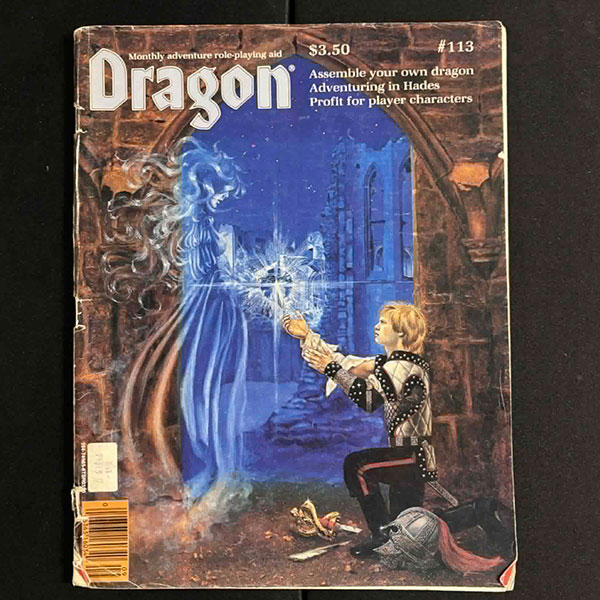
With Dragon Magazine #113 (September 1986), we are entering the era when I can safely say I acquired every issue I bought from the stand at the Compleat Strategist in midtown Manhattan. Before that, there was a small chance I picked it up at Forbidden Planet NYC, back in their original location, when the downstairs was dedicated to comic book back issues and role-playing games. I don’t have a specific memory of buying it.
The cover—Robin Wood’s third contribution—is entitled, “What a Knight for Apparitions.” I like a punny title, but yeesh! It shows a young warrior down on one knee receiving a glowing sword from the ghost of a young woman with flowing wavy hair. They are in the middle of ruins, and the night sky twinkles in the background. I didn’t think much of it as a kid, but looking at it now I appreciate it more. There are details, like the broken sword and the helmet on the ground, the look of the ruins, that make the image seem less like a moment frozen in time and more like part of an unfolding story. Still, I think the weakest part is the apparition herself. She just is a little too wispy for how the image is rendered and lacks visual substance, something that, as one of the two central figures of the image, she needs to have, even if she lacks actual substance in the storyworld of the painting.
Oh, and for those keeping track, the cover to this issue is still attached (but barely).
Kim Mohan’s usual editorial describes spending his summer writing the AD&D Wilderness Survival Guide, a book I once owned, having bought it when new (along with the Dungeoneer’s Survival Guide) and that turned out to be completely useless to me. It approaches the game and the challenges of those environments with too high a degree of simulationism, adding unneeded layers of complexity that I would argue are impossible to consistently use and still run an actually engaging game of Dungeons & Dragons. I could not help but snicker when Mohan writes “I won’t say it’s good” because with hindsight I know it isn’t, and then feel sad when he goes on to add “it’s the best I could do.” Then again, he edited the famously error-ridden AD&D Unearthed Arcana and would go on to co-write what is widely considered one of the worst RPGs of all time, Cyborg Commando, so maybe the best he could do just wasn’t that great. Nonetheless, the Wilderness Survival Guide is impressive in terms of being packed with information about natural environments and fairly well-organized. I am just skeptical of the value it adds to a game of AD&D.
The Letters section is given to one letter and its long response. Bennet Marks, the author of “Hooves & Green Hair” from Dragon Magazine #109, has questions about changes to his article. It seems strange to publish such a letter as none of the three main items addressed seem like they’d lead to confusion for a reader, and I cringe at the author’s impulse to write it. Dragon’s contributors were mostly amateur writers who were not as aware of the myriad changes that might happen to a submission when it has been accepted for publication, and apparently more likely to be offended by them. Then again, in his response, Roger Moore, who served as editor for the article, makes what to me seems like a startling admission: that he likes to tinker with articles he edits, adding stuff to make them “more complete” and enhance “usefulness.” I certainly think that it is in the purview of an editor to feel that an article needs something added to it in order to be ready for publication, but despite having been accused of having a heavy editorial hand more than once, I can’t imagine adding something whole cloth without at the very least collaborating with the article’s author. So, maybe Marks had a point.
The actual changes discussed are beside the point.
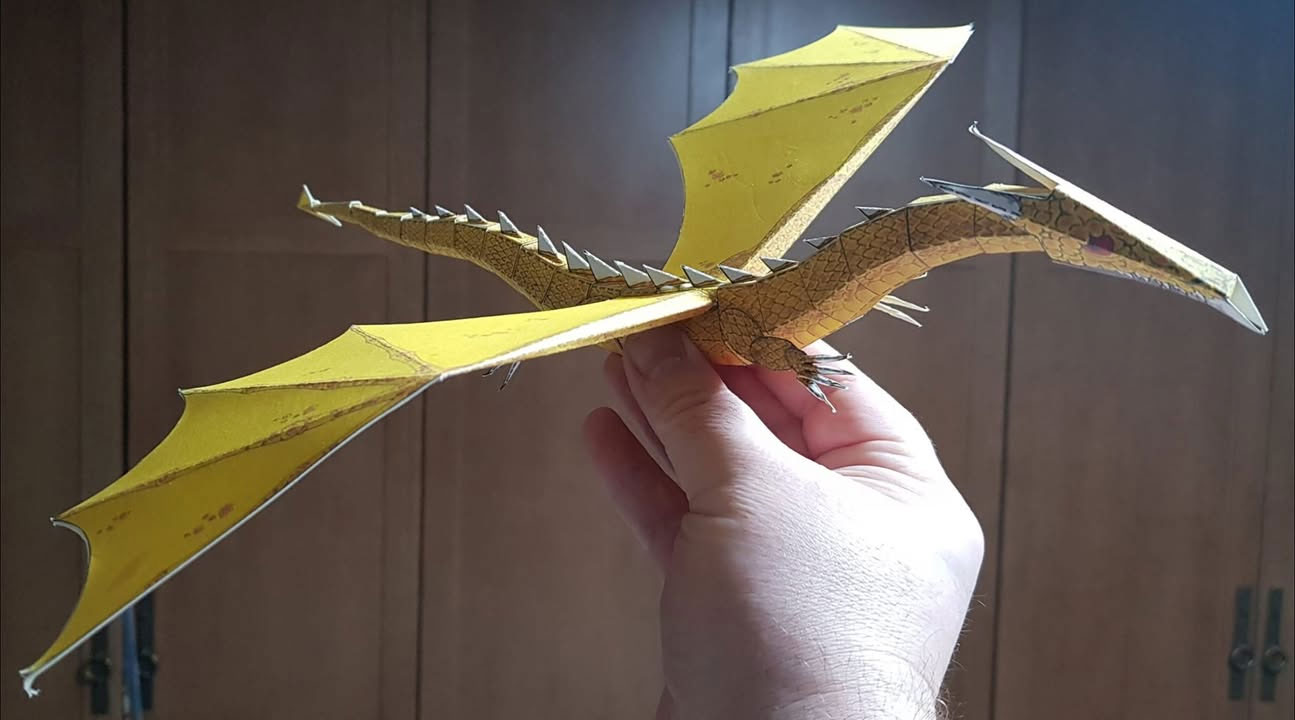
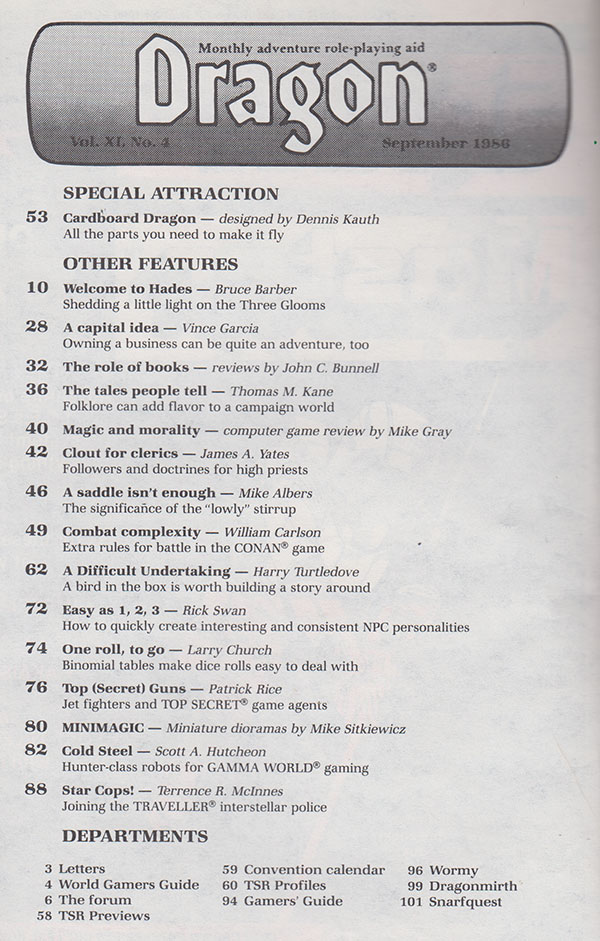
The issue’s special feature is a Cardboard Dragon, three sheets of thin cardboard holding pieces that you needed to cut out, and instructions for assembling it, requiring paste. It was designed by Dennis Kauth. This was not a punch out, tab, and slot kind of thing, but required careful construction with glue or tape. I tried it as a teen and vaguely remember completing it, but it also looked awful. I did not have the patience or the manual dexterity (or even a sharp enough pair of scissors) to do a good job on it.
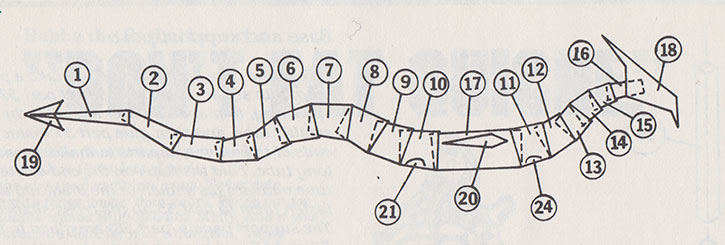
Looking at the instructions now, there is a lot of scoring and folding and gluing. The diagram for assembling the neck and tail is dredging up traumatic memories of trying it that I thought were long erased. It is made up of 16 telescoping paper cylinders arranged just so. And I don’t think I ever succeeded in assembling the stand to make it look like it was flying.
The cardboard dragon is something I think I could probably do a pretty good job on nowadays with a lot more experience painting minis and assembling terrain, but back then? If I had had even a little bit of wisdom, I would have not even tried and just waited a few decades.
This story will repeat itself when we come to the cardboard ship in issue #114.
The Forum opens up with new rules. Contributions are now limited to 250 words, should stick to one topic, have to be signed with a “real name,” and may be edited for length (but won’t be edited to be more comprehensible or less offensive, those simply won’t be published). These new rules are meant to hopefully decrease the number of letters that are “too long, too stuffy, or too snotty,” which is the common complaint from readers who do not care for the Forum.
The Forum letters this issue include a challenge to an article from #108 by Len Lakofka that I am not familiar with, another response to a complaining reader from an article author—Ralph Sizer’s “Locals Aren’t All Yokels” from Dragon #109—and someone else arguing for how their particular view of D&D “medieval fantasy” is the only reasonable way, and it defies logic to eschew some of the elements some players and GMs find onerous, like disease and poverty and overcrowding. Personally, I want my worlds to reflect the real world and some of its ills, too, but what I don’t want is for my personal preferences to be the metric by which all other D&D games and playstyles are measured.
Speaking of playstyles, while the planes have long been a part of D&D, they have never appealed to me as the focus of a campaign, and I prefer to hold them in reserve for a far-out high-level adventure near the end of a campaign, rather than an everyday sort of place to visit. However, Bruce Barber’s “Welcome to Hades” provides the details necessary for PCs to visit the Third Gloom of the plane of Hades (the one actually ruled by the plane’s eponymous god), building on the info presented in the rulebook formerly known as Deities & Demigods using various Greek myths and some standard D&D understanding of how the cosmos works, and yet manages to preserve the necessary mystique for it to function as “Hades” (if you get my meaning). Barber writes that “some areas are purposefully left vague” to allow a DM to better incorporate the place with their own campaign and/or setting. I appreciate this and it is my preferred approach to published gaming material. I have a hard time wrapping my head around some players’ need for canonical lore fleshed out to the nth degree. I am gonna always change stuff anyway, so too much detail can get in the way, if you ask me.
Barber suggests that his take on this plane is suitable for characters of 10th level or higher to explore. The article includes a small encounter table that ranges from as simple as a lowly ettercap (what the heck it is doing wandering around Hell?) or a stench cow, to a random devil or demon that could be of any power level. It provides details on crossing the River Styx, an interplanar barrier that must be crossed to actually reach Hades (and that has inspired me to include a version of in the cosmology of my current setting), the politics of the place, a Who’s Who of the tortured occupants like Sisyphus and Tantalus, stat blocks for Persephone and Orpheus (but no one else for some reason), and a very long list of spell alterations. For example, if a cleric were to try to cast Aid while in Hades, the recipient suffers the effect of a curse and takes 1d8 hit points of damage!
I know some people don’t like spell alterations for D&D locations, seeing it as a kind of nerf or cheat on the part of the DM, but for me, they are part of what establishes the vibe and peril of a place. As can probably be guessed based on what I wrote above, I never got into Planescape (and never even owned any Planescape products), but this article makes me wonder if this part of the Outer Planes was ever detailed in Planescape materials and to what degree it matches what Barber imagines for us here.
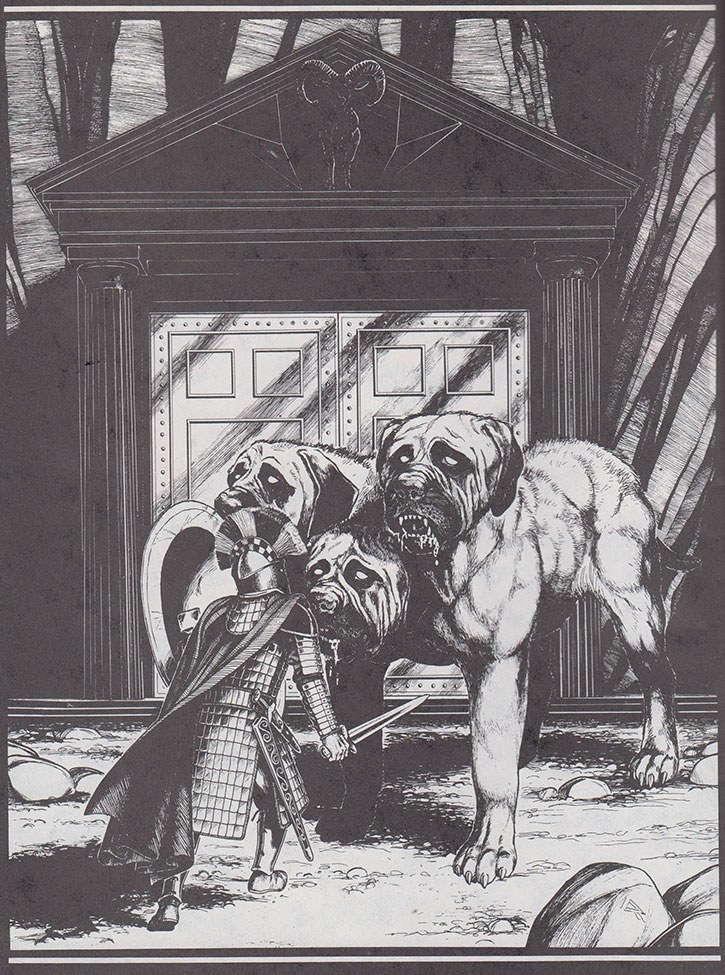
“Welcome to Hades” includes some cool artwork of a warrior confronting the three-headed dog, Cerebus, who is drawn to look like a kinda goofy mastiff. And another of Hades’s stygian marble palace. The monochrome black rendering in this art really captures the stark, cold, and foreboding feel of the place. I could not find who the artist is, because as usual, unless there is a notable artist signature in the art itself, there are rarely detailed attributions, in favor of a general listing of contributing artists. All that being said, the art accompanying this article is nearly all that is included in this issue. The sci-fi articles all have some perfunctory art, but nothing else does. I wonder why.
Vince Garcia’s “A Capital Idea” explores the possibilities of player characters in AD&D starting a business. He approaches the topic by addressing what he says are common questions that come up when this topic is discussed, first and foremost being, “In a world of action and high adventure, why would a player character want to become involved in something as mundane as running a business?”
Garcia answers this question by discussing PCs’ financial responsibilities and adventuring expenses, and by basically explaining the business as a kind of plot hook generator (though he does not use that term), and goes as far as to describe how he sees characters of different alignments approaching a business, with good characters wanting to benefit their community, neutral characters wanting more income, and evil characters seeing it as a way to accumulate influence and power.
The other questions Garcia explores include some AD&D-isms common to that era and ruleset, for example, he spends a lot of time discussing which classes may build businesses (remember, back then, class determined a lot of what characters were allowed to do). As such, paladins and monks with their strict vows of poverty are right out. Cavaliers and barbarians are both culturally unlikely to bother with businesses (from opposite sides of the issue, beneath the former and outside of the scope of the latter), and clerics have to be careful not to run afoul of their god’s or church’s expectations. Rangers, who back then were not allowed to own more stuff than they could carry, could start a business as soon as they reached the level at which point that rule is softened enough to allow them to build a stronghold.
Ultimately, the article provides some guidelines for the expense of starting a business and hiring a staff (building on rules from the 1E DMG) but gives very vague suggestions (left up to the DM’s imagination) for determining revenue that requires just kind of making up how successful the business is by imagining (for example) how many tables are full each night if you run an inn and the average sale per customer, etc… Yawn. This article requires a much simpler approach with a series of clear tables of something. I am all for characters exploring aspects of the game world beyond the dungeon, but I feel like its purpose should be developing the world and creating avenues for adventure, not that kind of arbitrary bookkeeping.
Let’s leave it by looking at one excerpt from the example Inn business detailed at the end that I feel illustrates my point:
“All of this arithmetic brings the total gross receipts of the inn to exactly 1,000 silver for the evening. Subtracting 75% of the gross for normal expenses, we find that Silverdirk’s net profit is 250 sp, or a little more than 12 gp. If Silverdirk does at least as well as this every night, it will take close to 3 years from the beginning of construction for Silverdirk to regain his original investment…”
“The Role of Books” covers books I am mostly unfamiliar with, though the Heroes in Hell shared world anthology (edited by Janet Morris and including stories by Gregory Benford and C.J. Cherryh) is part of a series I would end up sampling in the early 90s and bouncing off of pretty hard. And for what it’s worth, the reviewer has a pretty harsh view of it.
“The Tales People Tell” has Thomas M. Kane explaining how to make use of folklore in your D&D campaigns. In the process of doing this he breaks folklore down into four categories that don’t really seem mutually exclusive, but that he follows for the examples that take up a good third of the article: the horror story (good for warning about monsters), the wishful thinking story (good for baiting PCs for plot hook), the story just for amusement (good for establishing something about the NPC telling it), and the “story for a definite reason” (propaganda mostly meant to defame or praise). As you can likely tell by looking at these, they don’t actually seem like very coherent categories, but they work for his purpose. I like the example of the herb sellers who claim bugbears are attracted to catnip and get so buzzed off it, they are easily defeated. Oh and the folktale about a teleporting halfling (that turns out to really be a boggle) is cool too.
It hit me while reading this article (that I have no memory of from back in the day) that Kane’s name is a familiar one and a quick look at the DragonDex shows that he would end up writing 33 articles (between issues #108 and #218) for Dragon (most on D&D, but some regarding Top Secret). This is only his third, but he will have another in the next issue as well.
“Clout for Clerics” by James A. Yates (also his third article for Dragon) fills out the details of cleric character followers that are referenced but left far too vague in the AD&D 1E Player’s Handbook and Dungeon Master’s Guide. In addition to details of lesser priests, men-at-arms, and other servants that are drawn to the PC when they establish their own temple, it also includes guidelines for determining clerical doctrine, and developing territories around the temple both economically and culturally. I like this kind of article, because even though the rules themselves are out of date, the kinds of ideas it explores can be really helpful for domain style play (something I really wish I did more of with my groups).
“Easy as 1, 2, 3” is an uninformatively titled article on creating “interesting NPCs” by Rick Swan (presumably the same Rick Swan who’d go on to write several of the “Complete” class books from 2E). In this article, he posits a method of creating NPCs that seems a little too involved (I fear I grow repetitive). He describes an elaborate listing of adjective features for the NPC (based in part on Gygax’s tables in the DMG, which Swan criticizes for their vagaries and overuse of synonyms) to create a profile for the NPC, and even suggests “testing” these profiles to prep for games by imagining them in different scenarios responding to the PCs. This article really reads like something he thought up but can’t imagine him really doing? I somehow feel naïve if I accept either possibility. I think the idea of jotting down a few adjectives for an NPC you have to create on the fly as a way to remember them for a possible future encounter is not a bad idea, but all this pre-prep? It feels like a waste of time (and this from a guy who does A LOT of prep compared to many GMs).
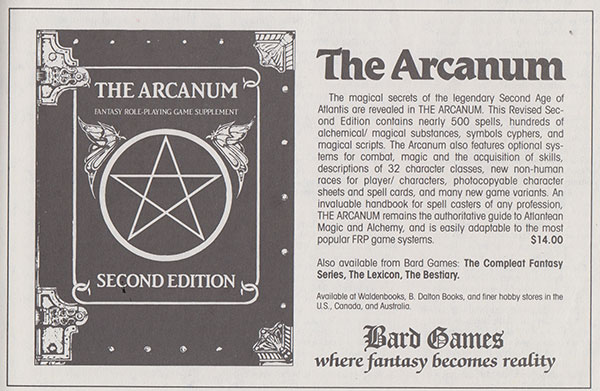
On this same page is an ad for The Arcanum (second edition), a now legendary third-party book that some people integrated into their D&D games. It had a ton of new classes and various ritual spells and so on if I remember correctly. It was a font of homebrew ideas from my perspective. Anyway, I had a copy briefly and regret getting rid of it. At some point I got it in my head that “officialness” mattered and I dumped the book. The fact that a friend gave me the book, rather than having paid for it myself, made it easier, I guess. Teens are dumb. The internet tells me that there was a crowd-sourced reprinting in 2019, but I have my eye on a couple of vintage copies on eBay.
“One Roll, to Go” by Larry Church is an amazing article based so much in math, you can’t help but admire the ingenuity of this friggin’ nerd to find a way to mathematically condense many “to hit” rolls (what we’d call Attack rolls these days) into a single roll. In other words, Rick the Ranger charges a curtain wall upon which are 50 archers aimed at him? You don’t need to roll 50 times! Using the tables Church presents here, you can quickly determine how many hit with one roll (of a d100)! He presents tables for 5, 10 and 20 rolls. So, for 100 attackers you would still have to roll 5 times, but still, that’s an improvement. Of course, if you don’t have even multiples of 5, things get trickier. This is really middle school level math, but who of us paid enough attention in middle school to easily grasp now what an app can do in seconds? Anyway, I love the idea of this table and want an excuse to use it.
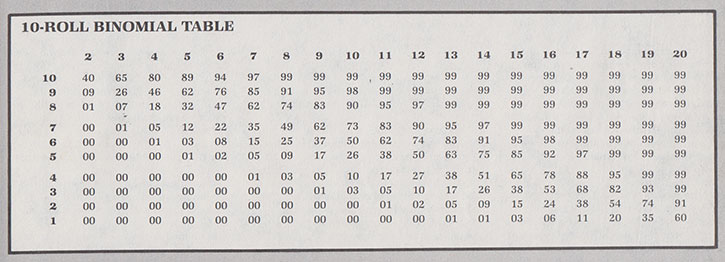
But oh, does it read dry as dust on Dark Sun. Woof! Here is a bit from where he explains the math behind it.
“Now let’s consider a concrete example: The “10” on the 5-Roll Binomial Table. There is an 11-in-20 chance of rolling a 10 or better on a 20-sided die, which corresponds to a .55 probability. Since the five rolls are independent, the probability of them all being 10 or higher is found by multiplying them together: .55 multiplied by itself five times equals .0503, or about 5%. Subtracting 5 from 100 yields 95; this is the number that must be rolled on the percentile dice to simulate rolling 10 or higher five consecutive times on a 20-sided die.”
But I love the article all the more for its audacity to assume its audience has the patience, reading comprehension, and basic math skills to follow it, and for the editor’s moxie in printing it and his wisdom in limiting it to two facing pages—easily skipped by those whose eyes glaze over at the appearance of any arithmetic.
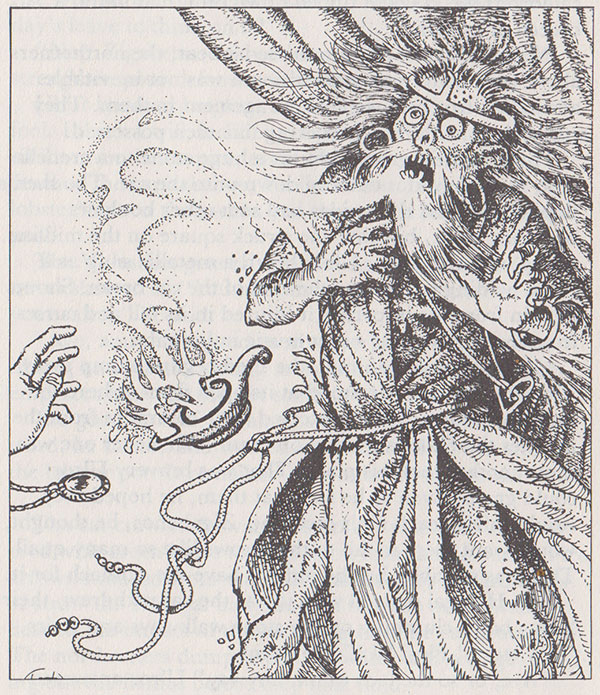
The short fiction—“A Difficult Undertaking”—is by Harry Turtledove, a name I recognize, but whose work I am not familiar with. I have no memory of reading this story back in the day. The story takes place in a generic fantasy world, and honestly the fantasy element feels unnecessary, but the glimpse of the setting’s politics reverberated with something I am working on for my own homebrew, so it was inspiring. Unfortunately, the story goes on way too long for what is ultimately an excuse for a couple of puns. The title, as it turns out, is a pun as well. Weirdly, aside from those puns, this is not trying to be a funny story! Despite this, I would read another Harry Turtledove story to confirm if this was common to his writing or if the elements I did like are developed further in his work.
The TSR Profiles are on artist Keith Parkinson (who had a hard time giving up on his dream of being a professional rock musician in order to become an illustrator) and Bruce Heard (who wrote translations of D&D products into French, and who got his job by writing Gary Gygax a letter). Parkinson would go on to do art for Magic the Gathering and Everquest. Heard, of course, will go on to write the Voyage of the Princess Ark article series for Dragon Magazine, but we have a ways to go before we get to those (issue #153, which I don’t even think I own).
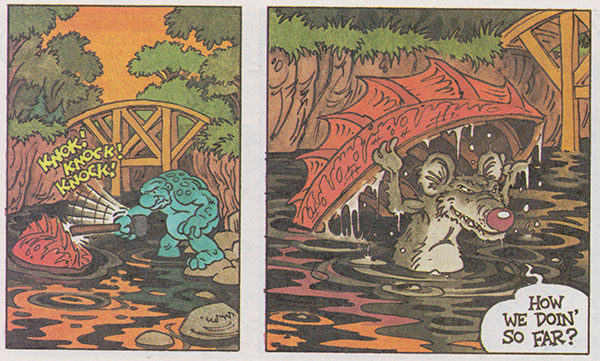
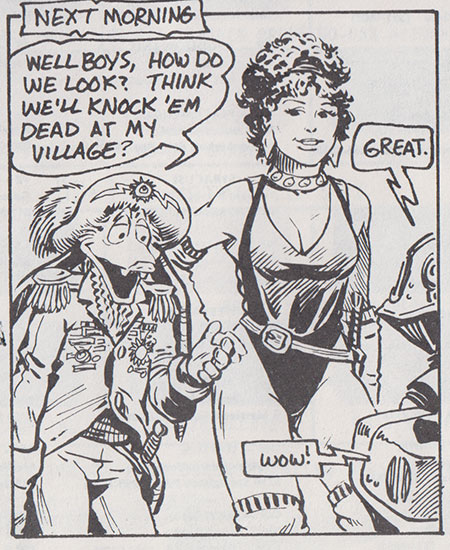
Other articles found in this issue include a short review of the Ultima IV computer game (I never played it), an article on adding a lot more realism and detail to saddles and how they are used in your AD&D game, additional rules adding complexity to TSR’s Conan Role-Playing Game (which came out in 1985 and was designed by the man who’d do most of the revision of AD&D into 2nd Edition, Zeb Cook), rules for military aircraft in TOP SECRET, Hunter-class robots for Gamma World (I remember creating a version based on these for Star Frontiers), and “MINIMAGIC,” two facing pages with Marvel Superhero dioramas featuring miniatures of characters like Doc Ock, Spider-Man and Dr. Strange. The photos aren’t great. They are too dark and rendered with insufficient detail. Sad. “Star Cops” gives us a look at law enforcement in the Traveller game. There is no Ares section anymore, but there seems to be just about as much sci-fi, modern, and superhero stuff as when there was…at least so far.Wormy is a delight, as it frequently is, Dragonmirth is best left unmentioned, and in SnarfQuest Snarf and Telerie climb aboard a spacecraft, learn about their planet and where Aveeare comes from, meet another robot, and then take off to return to Snarf’s village, as it has been a year since he left and he has to get back in that time for some reason I can’t remember. Oh, and there is a little more creepy stuff. Snarf keeps the robots from telling Telerie that the lingerie she chooses to wear from among the “exotic clothes” on the ship may not be appropriate for everyday wear, so that he can ogle her. The whole “joke” suggests both that Telerie is too stupid to understand what these clothes show off, and finds humor in Snarf’s leers. It just reads as sophomoric to me, and the fact that I was indeed a sophomore in high school at this time, I can confirm that I was an appreciative audience. Reading it now makes me feel oogy.
I can’t say I ever really used anything from this issue, and only the now missing cardboard dragon and “One Roll, to Go” are at all memorable to me. Ultimately, I do like “Welcome to Hades,” even if I am unlikely to ever make use of it, and I am glad I read Turtledove’s story just for the idea it gave me. And heck, that is how a magazine like this works best, in my opinion, as a source for inspiration.

