Dragon Mag Monday is a sporadic series I am trying to publish more regularly. In it, I review my collection of Dragon Magazines as I reread them for the first time in decades. My collection includes issues ranging from the mid-1980s through the 1990s and even a handful from the Oughts. Material from Dragon was a huge influence on my gaming, especially running Dungeons & Dragons, and part of the point of this series is to explore those influences. However, as I read them, I hope to scratch a bit at the surface of what was going on culturally (both in the TTRPG subculture, and American culture more broadly) and reconsider what I find through the lens of the current moment.
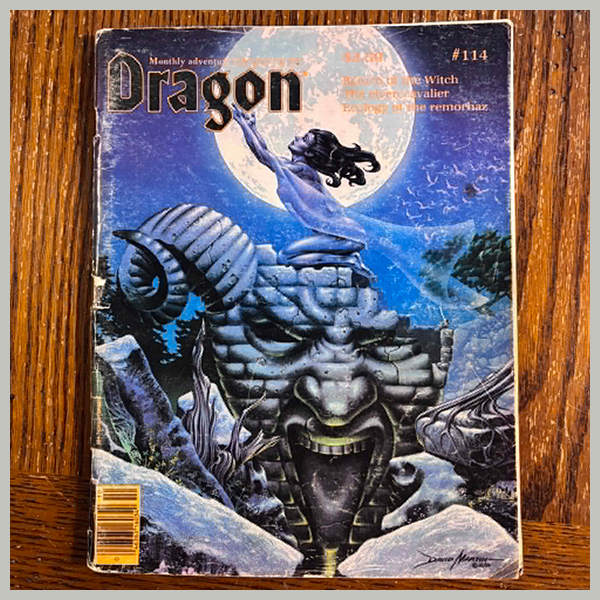
My copy of Dragon Magazine #114 (October 1986) shows some wear. There are stress tears around the staples, but the scuffed cover is still attached. And oh, what a cover it is! “Spirit of the Night” by David Martins is bound to be a topic of conversation in the letters and in the Forum section of future issues, due to the controversy surrounding what it depicts.
It is a night image conveyed nicely with blue saturation. A woman, shown in profile, kneels atop the head of a demonic idol. It has an open mouth, a protruding Gene Simmons tongue, squinting dark eyes, and one curled ram’s horn, as the other is broken off. It stands among the rubble and ruin of some sacred or unholy place. The woman is naked, save for a diaphanous translucent shawl. Her arms are reaching up, her hands open, her eyes closed, as if in supplication, and her black hair is swept back in the night wind. Her expression is inscrutable to me. The moon is full behind her.
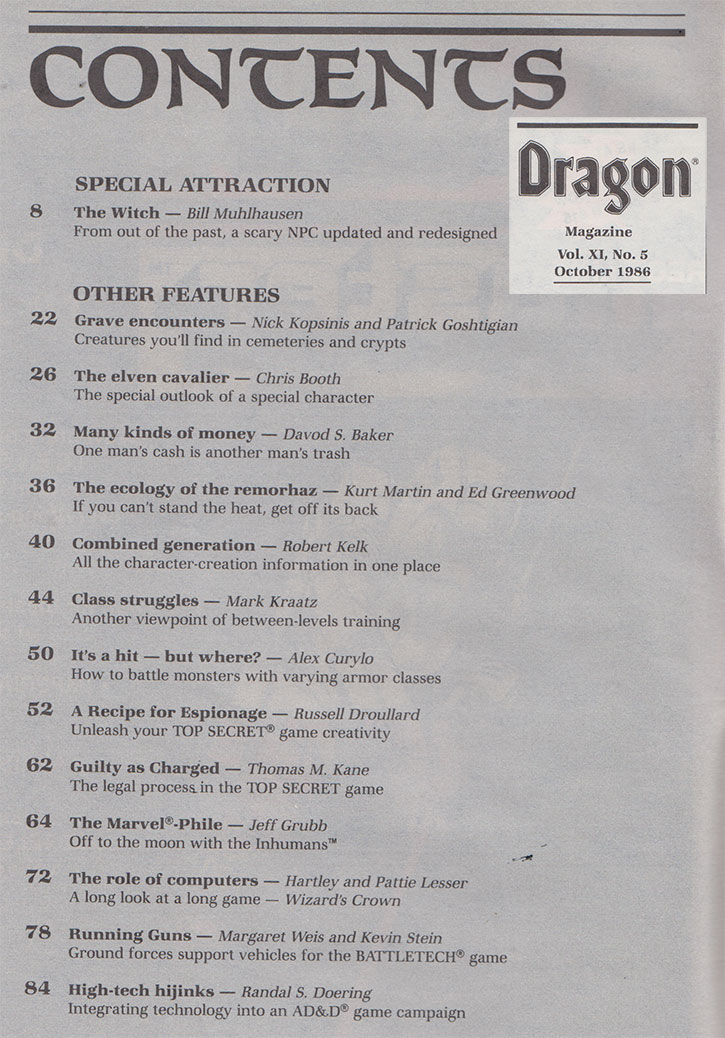
The controversy of course will primarily be about the nudity. If I remember correctly, there will be at least one future letter complaining about its occult devil-worshipping vibe during the height of the Satanic Panic, but mostly it will be about what I consider to be pretty tame nudity. Yes, you can see a boob. Yes, you can see the curve of where her ass meets her hip. The writer’s discussion of his own work on the table of contents page, describes the “elemental night wind” as “aroused” by her, which definitely gives sexy vibes in terms of authorial intent (for whatever that’s worth).
I like the cover. I am not so much of a prude that I think the naked human form is not a worthy subject of art, and I find bodies of all shapes and sizes fascinating, honestly. The range of how human beings are built is kind of amazing. I also like its attempt at a positive representation of “witchy” stuff during a time when there were social (and sometimes legal) consequences for it. It will be interesting to reread the arguments about risking the ire of the “concerned moms,” when it comes to fear of being painted with the satanic brush, because personally, I think there is value in directly defying that kind of pearl-clutching behavior—even if I also understand TSR softening and removing the devil stuff as a business decision.
All that said, I can understand the objections of those subscribers who were not happy to have a magazine with a naked woman on the cover show up in their mailbox or on their doorstep. I think an absence of nudity is a reasonable expectation of its readers given past Dragon covers and it being an all-ages magazine (or at least, it doesn’t purport to have a recommended age), even if the occasional chainmail bikini pushes that boundary. I am even more sympathetic to those who were disappointed to see that once again in a subculture where women are under-represented (especially at that time), women continue to be framed using the male gaze to titillate the imagined adolescent (or adolescent-minded) male audience, rather than as a participant in a community, becoming more of an object than a subject.
And I’ll add that, as a 15-year-old straight boy at the time who did not live in the porn-saturated post-internet world of the 21st century, that cover certainly was titillating, and I spent a lot of time closely examining the forbidden lines of her body. But we’ll return to the cover when and if I stumble upon the letters I remember coming in future issues.
Moving on, from cover onward, Dragon Magazine #114 is a very memorable issue for me. Paging through it in preparation for writing this overview, I was struck by how much of it not only shaped my D&D homebrew worlds and general preferences, but how it goes on to influence my D&D gaming to this very day, including things found in my current homebrew ruleset, Vanity Frankenstein 5E.
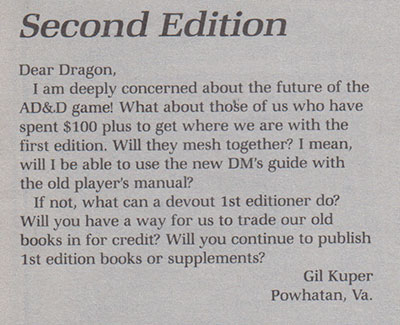
The issue’s editorial is given over to Roger Moore (who will soon be taking over from Kim Mohan as Editor-in-Chief), where he tells the story of someone impersonating him at San Diego Comic Con. He was clearly annoyed by it, but ultimately not a very interesting tale. In the Letters section Zeb Cook responds to someone writing in to ask about AD&D 2nd Edition (after the comments from Gary Gygax in Dragon #103 about what it might look like) and worried that after sinking money into AD&D books, that they might suddenly be out of date. Cook explains that drafting the 2nd edition is now in progress and to expect changes to the stuff hardly anyone uses (like encumbrance and weapon speed factors) and stuff that is just unclear and impossible to use as written, like the 1E Bard. He also mentions how the new edition will not force everyone to abandon their old books and that the new edition should be largely backward compatible. In my experience, as someone who never stopped using AD&D 1E and BECMI stuff back when I ran 2E, that degree of backward compatibility was perfect for its time. I also find it notable (though I did not notice at the time) that Zeb Cook is the one responding to this and not Gygax himself. Of course, what most readers did not know was that by the time we were reading this, Gary Gygax was already getting rousted from his own company, and thus the shape of 2nd edition would be (thankfully) out of his hands. We know now that Zeb Cook will end up being the lead designer on 2E, and we will hear more from him in coming issues.
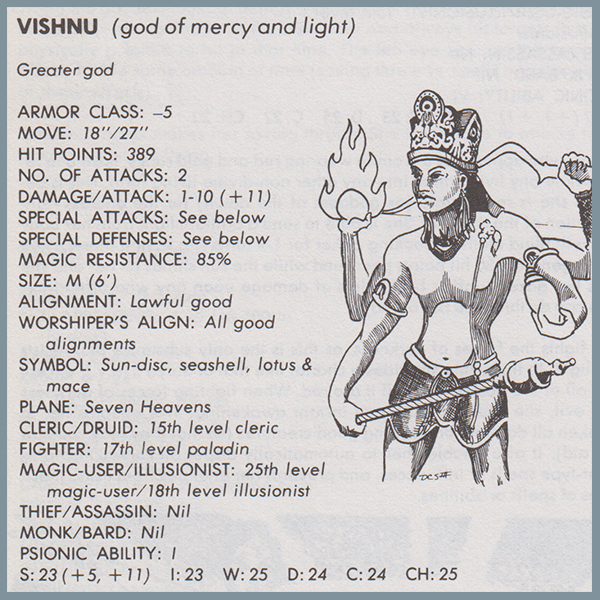
In the Forum, there is a response to Margaret Foy’s letter (in Dragon #112) regarding the use of real-world religious figures in D&D from a Roman Catholic priest. While he agrees with her that quantifying real-world deities in game terms to be battled and defeated could be disrespectful, he makes the unsubstantiated claim that it is not only “minority religions” that have been incorporated into AD&D, but also religions such as Christianity, Islam and Judaism. He does not, however, give any substantive examples, except saying that figures like St. Cuthbert and the entire idea of the cleric character class are somehow equivalent to giving Vishnu 389 Hit Points and a -5 Armor Class, or whatever…. He also compares it to religious parody in film and literature. It feels like a weak argument that does not take into account the relative social power of these different religions in the West, even as Foy in her original letter did not consider that these “minority religions” are not so “minor” in other parts of the world or that there are essentially dead religious beliefs (or recreated from fragments) that I think are open game for inclusion. I don’t think anybody is gonna get too offended if you end up fighting Hermes and stealing his winged sandals, or whatever.
Another Forum letter is another objection to female limits to ability scores, while a third is a complaint about the recent changes to Dragon’s typesetting and font use. Letters objecting to “Armor Piece by Piece” from Dragon #112 (for running counter to the abstraction that is armor class and hit points), and using SCA experience to claim that using two weapons at once should be easier than the rules make it rounds out those included. (I guess Andy Paris of Tennessee would have to wait for 5E for this to really come to fruition).
The first big article of Dragon Magazine #114 is one that matches up thematically with the cover, “The Witch” by Bill Muhlhausen and that has influenced my view of a Witch/Warlock class for D&D ever since. My changes included using this “NPC class” (see Best of Dragon IV for my opinion on why Dragon Magazine focused on NPC classes rather than new classes meant for players) as a character class in AD&D 1E and early 2E, and later changing the 3E sorcerer class, and more recently the 5E Warlock class, to be a lot more like it in theme and power.
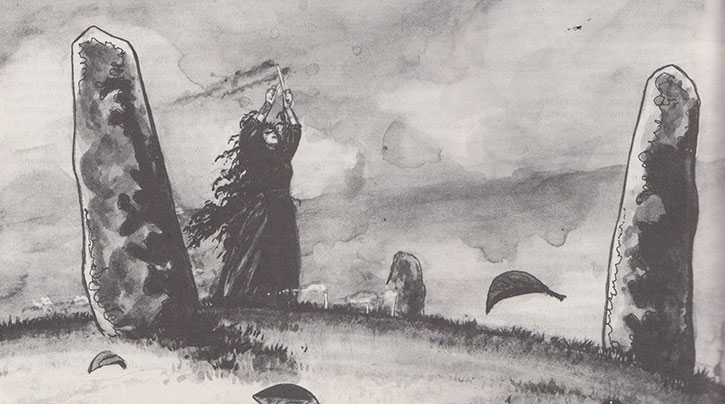
The article makes reference to a Witch class first presented in Dragon #43 (November 1980), which I don’t think I have ever looked at, or if I did, it was after I had already read and incorporated this one. Muhlhausen’s Witch does not go all in on the idea of a more positive attitude on witches and witchcraft. For example, it describes them as having a “decidedly evil nature,” even though technically they could be of any alignment. It also makes women the most successful and powerful witches and reinforces this by granting them spells that specifically charm groups of men. You must beware those evil feminine powers, I guess.
The section describing a witch’s followers reminds me of how stridently expressed the expectations for role-playing a particular class could be back then, even when there wasn’t a mechanical component to violating it. The paladin, ranger, and monk are examples from the core 1E Players Handbook with mechanical consequences tied to character behavior, and the barbarian and cavalier from Unearthed Arcana have similar role-playing restrictions or expectations, but here we are told that that the witch “insists on governing all underlings with absolute authority regardless of alignment.” Further developing the notion that members of certain classes must behave in a certain way.
These witches also gain other abilities. They have special candle magic and can brew potions and drugs. Brewing potions is something I still give to my version of a—deeply inspired by this article—5E Warlock. These witches have their own spell list which include new spells, like the aforementioned “Charm Man,” along with existing spells from a mix of Magic-User and Cleric lists. As with many things 1E, spells like Charm Man have vestiges of D&D war game roots by including subsystems for resisting such a spell if the men targeted have a “leader” present.
Perhaps it goes without saying, but these kinds of game rules based on ideas of gender and desire are not only generally problematic in how they erase a whole spectrum of gender and sexuality, but I can imagine quite a few cases where they would be complicated to adjudicate in actual play. If someone had told me that Hȏl, the cleric of Ahto I played for four years was ensorcelled by the magnetism of a woman, when I explicitly made him attracted to men, I would be very annoyed. Just let it be a charm spell, and take the gender aspect out of it.
The word “coven” does not appear in the article that I could find, but it spends a lot of time describing in great detail the organizational structure of witches, who have “High Secret Orders,” which provide very powerful “High Secret Order Spells.” Each of these orders are tied to a specific deity and are described as being constantly at war with each other. I am not a fan of this kind of limiting factor outside of a specific setting where it is tied to lore and culture. While I imagine warlocks/witches as having some covens in my current setting, I mostly see them as part of older village culture, part-wizard part-druid part-alchemist and making deals with otherworldly beings in return for power. The specifics of how they may or may not be organized can be collaborated on with players within the framework of the setting tone and themes, as can how a character might resist those themes.
But there is something about the general tone of this version of the witch that left its imprint on me—the sense of mystery, ritual, and arcane promise from otherworldly powers—the vestiges of which can still be found in my current play. Speaking of leaving an imprint, the next article, “The Elven Cavalier,” was essentially taken as canon by me and my friends back in the day. I can remember photocopying this article for friends because the elven cavalier was so common a character in the era of Unearthed Arcana—what some folks have retroactively dubbed 1.5E.
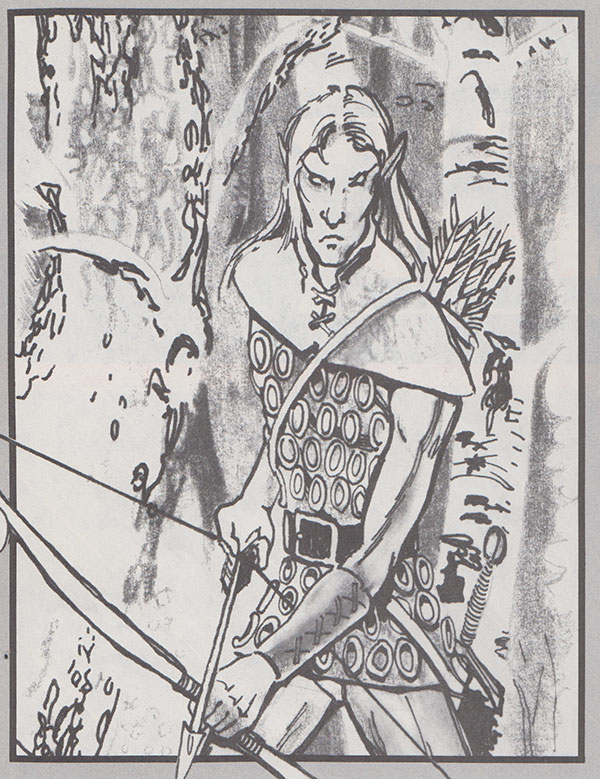
I don’t honestly remember much about the cavalier class from the 1E Unearthed Arcana—a book widely considered a mess of untested and overpowered options for AD&D compiled mostly from Dragon and designed more with the goal of filling TSR’s dwindling coffers than actually trying to make the game better. Still, it had some interesting ideas. What I do remember are tidbits like a strict honor code, paladins becoming a cavalier subclass (instead of fighter), and they had a way to increase their physical stats as they advanced in level. The class was rooted in the mounted knight archetype and got proficiency and other bonuses with lances and swords, and had access to some of the best plate mail armor.
I absorbed Chris Booth’s “The Elven Cavalier” like a Master Class in how to adapt game ideas to emulate cultural differences. I saw it as a lesson in how to use game rules to reflect the reified organizational aspects of the setting. In other words, while we took this article adaptation of the cavalier concept to reflect a mounted sylvan archer to be gospel, it simultaneously showed me an example of how I could homebrew and house rule to further develop specificity and a sense of place.
True to form for older versions of D&D, despite being a class (or really a class and race combination) focused on the mounted archer, shooting from horseback still had significant penalties. Presumably these penalties are not as severe as those suffered by a non-elven cavalier shooting from horseback, but since 1E rules are scattered and consist of multiple inconsistent mechanical subsystems, I had a hard time finding what the general penalty might be. In fact, as far as I can tell, the 1E Dungeon Master’s Guide (where combat rules were relegated, purposefully keeping these rules out of the hands of players), has no rules about firing from horseback whatsoever. The AD&D Oriental Adventures does provide penalties for firing from horseback (depending on how fast it moves), and allows for eastern style great bows to be used from a horse (something the 1E rules prevent—though I am not sure which book it appears in). These rules do not line up with the ones presented in the article. The OA rules apply attack roll penalties based on the mount’s speed, while the “The Elven Cavalier” presents no attack roll penalties, but limits rate of fire (halving it) and reduces the mount’s maximum speed by 25% when the elven cavalier is riding and shooting. Aerial mounts are also less maneuverable when the rider is firing a bow. Personally, I find the article handles this backward, and whatever the specifics of the penalties might be or not be, I think the behavior of the mount should influence the firing of a bow (how OA handles it) rather than firing a bow influencing what the mount can do.
Along those lines, another thing that stood out to me was that one of the elven cavalier’s class abilities is “Ride and Handle Horses,” which makes obvious sense, I guess, but not only is this very basic ability delayed to 3rd level, there is no mechanism for this built into the rules (I guess non-weapon proficiencies were just becoming a thing with the arrival of the aforementioned Oriental Adventures). The question for me is, are there any rules that pre-exist this class that claim other classes cannot also ride and handle horses? These kinds of rules were more common back then, a generalized claim of ability that was not reflected in the rule set.
Booth spends time detailing differences in cultural weight between the customs of human cavaliers and elves. For example, shield insignia is not as meaningful for elves, but they use elaborate motifs woven into their clothing and gear (like quivers) and have bejeweled arrows, for which we are given a list of meanings. Another example Booth gives is of wings on shoes and boots.
The majority of the article focuses on what it calls “class attitudes,” with a long exploration of the elven cavalier honor code and the expectations for their behavior upon which rest being able to retain the class at all. Booth explains how elven ideals of chivalric honor temper the martial fury associated with the “Death before dishonor” precept. This is the meat of the matter for me because, as I mentioned before, it takes the moral ideals of the class as presented in Unearthed Arcana and applies them to a different cultural framework and coming up with something that adheres to the basic understanding of the archetype but provides a new way of thinking about it. This approach comes to its fruition in the kits of the 2E class option “Complete” books, and also manifested in 3E’s prestige classes. Great stuff. In fact, my 2E house rules included a homebrewed elven cavalier kit based on this article (before they, the latter especially, became decontextualized bags of rules to use towards a “build”).
“Many Kinds of Money” by David S. Baker is another banger on the playlist of articles that fundamentally influenced my DMing style and worldbuilding. In it, Baker explains how to build immersion and sense of texture to your D&D setting by creating different coin types and descriptions based on nations or regions, giving examples from his own homebrew regarding how the abundance or importance of resources can influence what money looks like, how it is valued, and even what it is made from. He also discusses rates of exchange between nations. I took all of this to heart when establishing my long-running homebrew—Aquerra. These days I am a lot less likely to spend time making exchange rate charts like I did when I was 17 or 20, but even in current games I have described coins from different realms and eras, and the increase of electrum in the local economy was a clue about the influence of foreign money laying the groundwork for an invasion.
“Class Struggles” by Mark Kraatz presents a system for time and cost of training between levels from which I based my own system that I used as recently as 2009 (though I played in another game which used those rules, that ended in 2016). What I liked about this system was that it only required training when a character gained a new class ability, spell level, or weapon proficiency. You did not have to train if all you were getting from a new level was another Hit Die and maybe a better chance to hit on the attack matrices. Instead, you trained for stuff like gaining 3rd level spells, gaining wildshape, or the ability to turn undead. This meant that certain classes, like the fighter, needed a lot less time and expense training, while wizards and others needed more. I would add rules for training for non-weapon proficiencies when adapting to 2E and later in 3E, skills and feats.
“Class Struggles” also includes rules for self-training after achieving a certain level determined by class (it takes as much time, but costs half as much) and in a few issues there will be an article (whose title I cannot currently remember) that modifies the time required to train based on a character’s intelligence (something I would later adopt and modify to use a class’s prime requisite when appropriate instead).
The rest of this issue includes some articles I recall, but that were not as influential on me. In “Grave Encounters,” Nick Kopsinis and Patrick Goshtigian fill a notable gap by providing encounter tables for two different kinds of graveyards—“typical” and “evil-enchanted.” I may not use random encounter tables frequently, but I do use them, and having ones built around themes and with probabilities mapped to rarity and power of creatures listed is convenient and easily adapted to your own setting. “Combined Generation” by Robert Kelk, is similarly trying to aid other D&Ders by putting together all the different character creation tables—from five different places in two different books—into one place. Now you can easily see that the maximum Charisma of a half-orc is 12, while considering the Valley Elf (totally tubular!) has a maximum Strength score of 18/75. There is even a table combining all the minimum ability scores for different classes in one place. Cavaliers have a minimum Strength of 15, but Clerics only need a 6 or better.
“The Ecology of the Remorhaz, co-written by Kurt Martin and Ed Greenwood, puts our Greenwood Count at 18. As is usual for this series, the article uses a narrative of encountering the monster to reveal information about the winged arctic fire worm (one of my favorite monsters, actually, but only used once about 35 years ago). The story is supplemented by footnotes which puts things in game-rule terms.
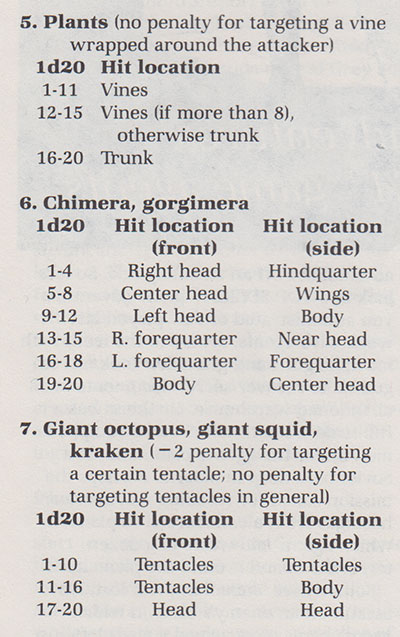
“It’s a Hit, But Where?” by Alex Curylo continues the long tradition of adding complex specificity to D&D combat. The article provides hit location tables for humanoids, for “lions and dinosaurs,” for insects, and for chimerae, among others. This ruleset emerges from Curylo’s desire for more codified rules on the smattering of monsters in the Monster Manual and elsewhere that have different armor classes listed for different parts of their bodies, but with no rules for targeting individual places. Of course, this evolves into aiming for different parts of opponents for different effects, adding a whole other layer to combat. I vaguely remember trying these tables, as I often tried lots of complex subsystems I encountered in Dragon, but dropped it quickly. Adding the complication of training rules as a skein of downtime activity through which adventures are threaded is one thing, but adding a whole page of additional tables to reference during combat is another.
Despite the cancelation of the ARĒS section, Dragon Magazine #114 also has two articles for TOP SECRET, along with the Marvel-Phile (covering the Inhumans and their lair in the Blue Area of the Moon), “The Role of Computers” (reviews Wizard’s Crown positively), and “Running Guns” (rules for ground vehicles in Battletech).
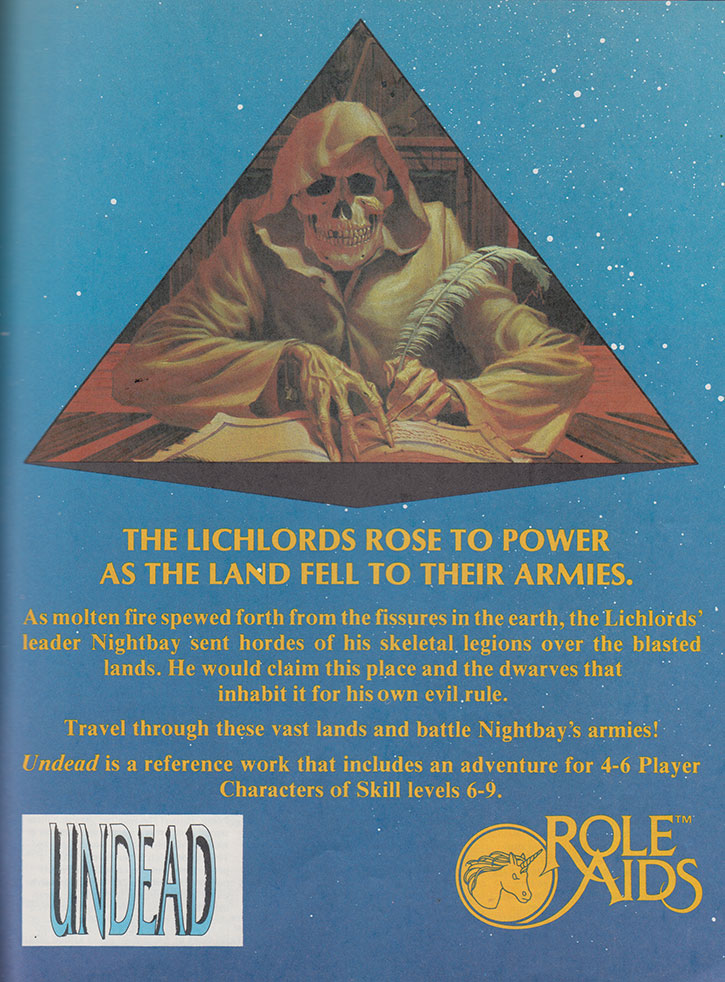
A full-page ad for the UNDEAD installment of Mayfair Games Role•Aids supplements stopped me in my tracks because in about 4 or 5 years, I’d find a copy in a discount bin and end up incorporating most of its lore and its concept of an undead nation stolen from dwarves—who have ripped off their beards in dismay and never letting them grow until their lands were returned to them—directly into my Aquerra setting. I changed some names of places, but it was too good not to use, even if their “not quite D&D” presentation of rules material felt off. Of course, Mayfair would end up a target for TSR’s infamous litigious streak, especially for putting a “Compatible with Advanced Dungeons & Dragons” call out on the cover of some of these products. Eventually Mayfair would sell TSR the rights to the line in a settlement, and the latter killed it. This suggests that Wizards of the Coast still owns those rights and could do something with that material. The ad is not really very appealing or informative, despite the cool lich image. It calls the product a “reference work that includes an adventure,” which is not very evocative, though the copy about the lichlord and his undead horde tries to sound appealing.
Buried in the issue is “High-Tech Hijinks” by Randall S. Doering, which is six pages considering the effects of introducing high technology items like force swords and gauss guns to your AD&D game. While this is certainly something that happened in D&D games, by the time I got this issue, I had gotten it out of my system and was becoming the kind of genre snob I loathe now. Even now, when I would be much more open to exploring that kind of gonzo space, nothing in this article of reasonable considerations stood out to me.
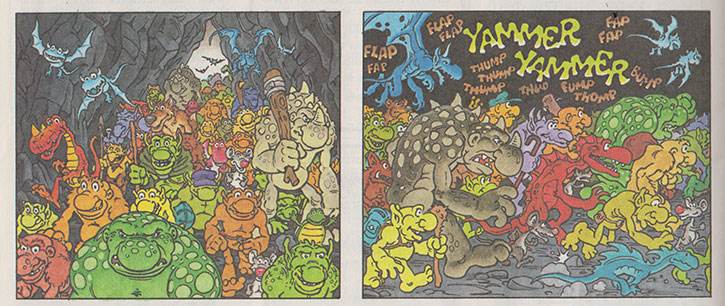
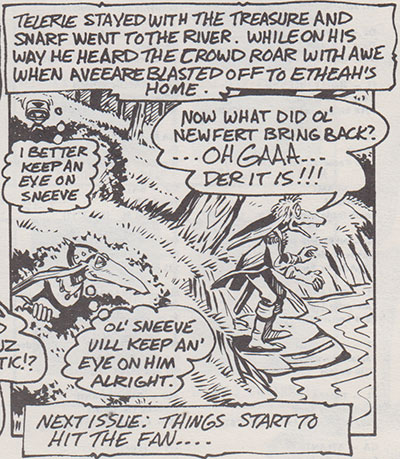
In Dave Trampier’s Wormy, countless little trolls arrive at the titular dragon’s lair to begin work on his war game space. While in SnarfQuest, Snarf and company arrive in Zeeville only to have his claim to their kingship challenged by another seeking the crown. What could this rival have accomplished to weigh against arriving in a gosh-darn spaceship? We aren’t shown yet, but I think I remember. Dragon Mirth is the usual schlock.
We are heading into the era of my Dragon Magazine collection wherein I have long runs of sequential issues and my use of material (both rules and inspiration) happens a lot more often than it has so far. It makes me wonder if writing these overviews is going to slow down even more as I potentially have more to say about the content and how I used it. The next issue features another focus on thieves (with six articles this time, instead of three printed in Dragon #104) among a few other sources of inspiration for my games. I am looking forward to diving in.


Leave a Reply