n.b. The Rules Lab feature presents house rules and variants currently being used in my D&D games or that I once used and am experimentally updating for 5E. In this sub-series, I am presenting rules I am using or incorporating into the Vanity Frankenstein 5E (VF5E) homebrew ruleset. Furthermore, updates and other minor changes to the previously presented rules will now appear at the end of each post in this series. A link to download a PDF version of this article and the proposed rules can also be found below.
It seemed to make sense to follow up my post about VF5E’s rest rules, with one about Dying and Death Saves. I have used some form of ThinkDM’s rules for remaining conscious at 0 Hit Points for a few years now, basically since I discovered them. I use them as the basis for these new rules while exploring a few finer points.
In addition, I am using rules for “lingering failed death saves” (whose origin I unfortunately cannot recall), which means that if a player character drops to 0 Hit Points more than once during an adventuring day, they are closer to death each time.
Lastly, my in-person group has been using Lingering Wounds house rules for a few years now, but they have only come up twice, as there is only a chance to suffer one after having two failed Death Saves and an additional failed Constitution save. However, when used with the Vanity Frankenstein 5E rules, some of these results cannot be fixed without the most powerful magics. Meaning someone who loses an arm, might need to go on some quest to regenerate a new one, if they are not already of sufficient level to even attempt such magic themselves.
I still have some questions regarding corner cases for these rules, but having played with them for a long time, I am happy with how they play out. That is to say, they don’t come up so often as to disrupt play repeatedly, but enough to be a consideration and shape the action of the game. My only real remaining goal is for them to be easy for the players to remember. I will explore some of the benefits and potential drawbacks as I see them after the rules themselves.
The explanation of these rules begins with the details of the Dying and Dazed conditions, as the former subsumes the latter (e.g. if you are Dying, you are Dazed). As such, these rules may seem repetitive, but it’s important to remember that the Condition explanation would appear in the rules for Conditions, while the rules for Death Saves appears in its own location.
Relevant Conditions
Dazed. A Dazed creature can only take an Action or Bonus Action or move its Speed on its turn. It cannot take Reactions.
Dying. A creature that has dropped to 0 Hit Points is Dying. You immediately lose concentration on any spell you are maintaining, fall Prone, and cannot get back up until you regain Hit Points (at which point you are no longer dying). At the beginning of your turn, you must make a Death Save [see Death Saves]. A Dying creature with more Death Save Failures than Successes is Unconscious. A Dying creature that is still conscious is Dazed, and can only take an Action, Bonus Action, or move (crawl) on their turn. The only actions a Dying creature can take are the Attack, Cast a Spell, or Use an Object Actions, but they cannot cast any spells with a concentration duration or a casting time longer than 1 Action. They cannot take Reactions. You suffer Disadvantage on any Strength or Dexterity based ability checks or saving throws, and on any attack you make, and any successful attack against you while Dying is automatically a critical hit, and you automatically suffer two failed Death Saves.
Death Saves
A creature at 0 Hit Points is Dying [see Dying Condition]. At the beginning of each of its turns it must make a Death Save, which is an unmodified d20 roll against DC 10. If the Dying creature earns 3 successful Death Saves, they are stabilized. If the Dying creature earns 3 Death Save failures, they die. If at any time the Dying Creature has more Death Save failures than successes they fall Unconscious (and can wake back up if this ratio changes).
If the Dying creature rolls a natural ‘20’ on their Death Save, it automatically stabilizes and gains 1 Hit Point. If it rolls a natural ‘1’, this counts as 2 failures. A Hero Die can be spent to make a single failed Death Save you earned this turn into a success. [See Dying Condition for what you can do while Dying but conscious]
Stabilizing
While stabilized, you remain at 0 Hit Points, but no longer have to make Death Saves unless you take damage again. You cannot begin an effective Short or Long Rest unless you have at least 1 Hit Point.
If you stabilize while conscious, you still suffer the penalties for the Dying condition until you recover.
Recovery requires 2 to 8 hours of uninterrupted rest. And if you participate in even light activity, you must begin the rest again. If you are unconscious when you stabilize, you remain that way until you recover. After 2 hours, roll a Constitution saving throw. If you succeed, you regain 1 Hit Point and are Recovered. If you fail, you repeat the save after another 2 hours of rest. The save DC begins at DC 16, but is reduced by 4 every additional 2 hours. If, after 8 hours, you fail the final check (at DC 4), you are automatically Dying again and must make Death Saves each round (potentially restarting the whole process).
Accumulated Failed Death Saves
Failed Death Saves stay with you. If you fall to 0 Hit Points, earn a failed Death Save, are healed, and then fall to 0 Hit Points and are Dying again, you begin with 1 failed Death Save. All failed Death Saves are removed after a Long Rest. They can also be removed with the Lesser and Greater Restoration spells. [See New & Revised Spells]
Lingering Wounds
Being wounded enough to hover at death’s door has its own potential long-term consequences. Any time you suffer a second failed Death Save, roll a Constitution saving throw. The result of this roll determines if you have a Lingering Wound and its degree of seriousness. The Lingering Wound descriptions include information for successful recovery.
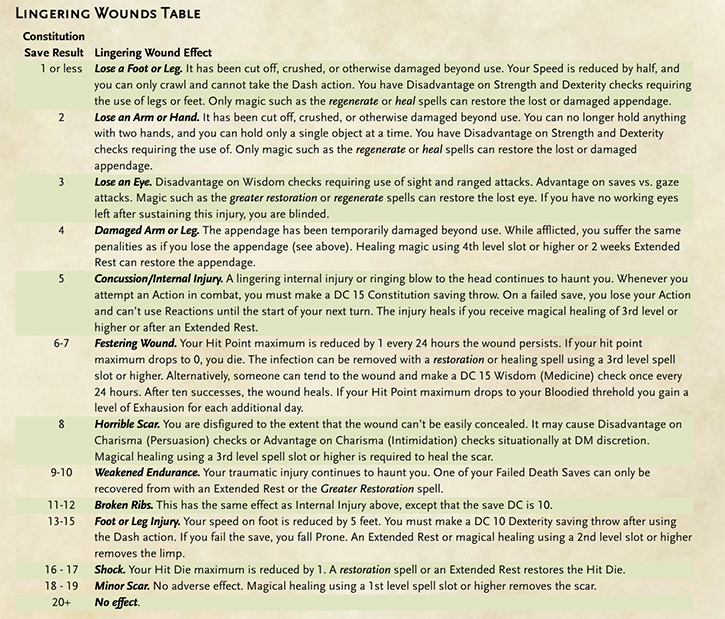
Notes on Lingering Wounds Table. When a result allows for a choice, such as between two limbs or appendages, simply roll a die to randomly determine which is affected, giving equal chance to all possibilities. Or, the DM might simply allow the player to choose which—leg, foot, hand, arm, left or right, etc—is lost or damaged. The DM might also present modified odds or consequences. For example, a character fighting with a melee weapon and a mundane shield may only have a 1 in 4 chance of having his shield arm injured, with the added consequence that the shield is destroyed in the process. Otherwise, it is their weapon arm that takes the blow. On the other hand, a DM might rule that a magic shield could reduce the severity of the wound (from lost to damaged, for example), or some other adjudication, as long as it narratively and practically makes sense to the situation.
What I like about these rules is that they give Death Saves an additional layer of stakes through which to perform heroic (or sneaky) acts. There is a shift in energy and drama when there is someone dying but conscious on the table—what will they do with those one or two rounds? Will they drink a potion or take revenge? It works best, for example and in my opinion, as when in a recent session, the PC paladin was dying at the same time as his protege NPC sidekick and he used his action to heal the sidekick, knowing he might fail his death save next time around and not get to heal himself before falling unconscious (the rest of the party was kinda stuck fighting undead so were unlikely to intervene). I also like how the mechanic allows for someone to fall in and out of consciousness!
One side effect of this that I consider more neutral, is that Dying characters who are still acting can pose a threat to enemies, meaning they are opening themselves up to being targeted while vulnerable. On the one hand, this also builds drama and adds a point of tactical consideration, but on the other hand, as a DM, I sometimes feel like a jerk when I have enemies target downed PCs, even when it makes sense (even though my players would not want it any other way).
The one potential negative we ran into was the peculiar case of druids. If a Dying druid of 2nd level or higher can take an action, then they can use Wildshape (2014) to temporarily gain a new pool of Hit Points through which to do stuff while delaying the Dying condition. Maybe this is not a big deal, but when it made defeating a druid antagonist in one adventure extremely difficult, it gave me pause. And then the PC druid started doing it. We put a moratorium on being able to wildshape while dying in that game, but I lifted it for my current in-person game and as of now plan to keep it that way for VF5E. It feels like a corner case. Sure, it may make druids seem much more attractive as a PC in terms of survivability, but I am not worried that the players at my table are all gonna show up with druids they want to play because of this. And you know what? Even if they did, that’d be great. I’d run with it.
Rule Addendums: Instead of going back and updating previous posts with changes to the rules since I published those, I plan to include a note about them in future posts as I do below.
For “Rules Lab: Rest & Healing,” I would add that an Extended Rest is also immediately ended (requiring you to start over) for any activity that leads you to gain a level of Exhaustion.
Click here to download a PDF version of this article and the proposed rules.


Leave a Reply